This post is about the soft palate: what it is, how to tell nasal resonance from nasality, and practical ways to lift and control it when you sing.
What is the Soft Palate?
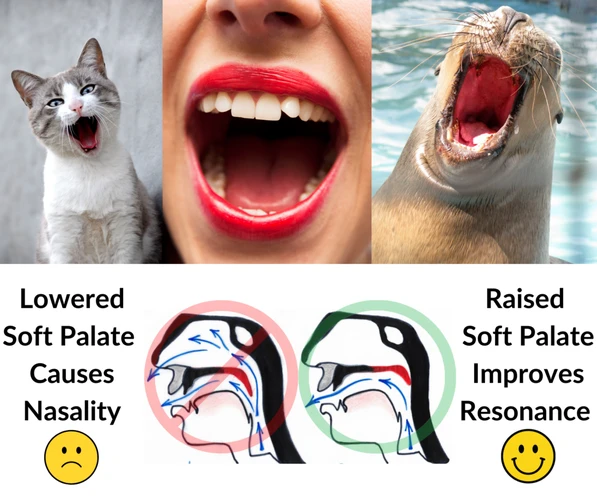
The soft palate (or velum) is the soft tissue at the back of the roof of your mouth. Unlike the hard palate in the front, the soft palate moves, and its position decides whether sound and air can pass into your nose.
- When the soft palate is lifted, it closes the passage to your nose, so the sound comes out mainly through your mouth. That’s what you want for clear vowels.
- When the soft palate is lowered, air flows into the nasal cavity, which can cause a nasal tone—an undesirable quality in most styles of singing.
Nasal Resonance vs. Nasality: What’s the Difference?
Nasal resonance and nasality are easy to confuse, and the difference matters:
Nasal resonance is the buzz you can feel in your face and nose when you sing. Even when the soft palate is raised and the sound goes out through your mouth, a little sound still reaches the nose. That buzz is a useful sensation to notice, and it happens without air escaping through your nose.
Nasality is a nasal color you hear on sounds that are meant to come out of your mouth. It usually comes from sound and air passing into the nose when the soft palate is lower than it should be. Nasality belongs on “m,” “n” and “ng,” and it’s generally avoided on vowels.
In short: nasal resonance is a helpful sensation, and nasality belongs on the nasal consonants.
Why Is a Raised Soft Palate So Important?
A raised soft palate helps you:
- Control nasal color: lifting the soft palate keeps your vowels from sounding nasal.
- Feel more space: a lifted soft palate gives a feeling of more room at the back of your mouth.
In English, the soft palate lowers for the nasal consonants “m,” “n” and “ng.” For all other sounds, especially vowels, keep it lifted. Your ear is the final check.
How to Check for Nasality
You can use three simple checks:
- Pinch Your Nose Test: Sing a long “ah” while you pinch your nostrils closed, then let go. Do the same on “ee.” A small change is normal, especially on “ee.” If the sound changes a lot, try more lift and check again.
- Mirror Test: Hold a small mirror under your nose while you sing a vowel. If the mirror fogs up, some air is passing through your nose. Try more lift and check again.
- Record and Listen: Record yourself singing. Listen for vowels that sound more nasal or “stuffy” than you want. Try the exercises below, then record again.
How to Lift Your Soft Palate
Here are some exercises and images to practice with:
The Yawn Sensation
Mimic the feeling at the very start of a yawn, before your jaw drops. That’s where you feel the soft palate lift. Practice finding that feeling while you sing. Stop at the start: a full yawn pulls the tongue back and drops the larynx, which changes your vowels.
The Inner Smile Technique
The “inner smile” is a useful image to help lift the soft palate, especially along the sides. Imagine that you’re smiling inside your mouth while your face stays relaxed, and notice whether it helps you find the lift.
Silent Laugh
Similar to the inner smile, think of the feeling of a silent laugh. Use it as another way to find the lift while you sing.
Substitute “B” for “M”
A great way to train your soft palate is to substitute a “b” for an “m” in words or exercises. For example, sing the word “moon,” but replace the “m” with a “b” (“boon”). The “b” needs the passage to your nose closed, because air pressure builds up behind your lips. After practicing with the “b,” go back to the “m” and notice how you control the airflow.
This technique works for the other nasal consonants too: substitute “d” for “n” and “g” for “ng.”
Exercises for Clear Vowels
If your vowels sound more nasal than you want, try these:
- Ng-to-Vowel Transition: Start by humming on “ng” (as in “sing”), which keeps the soft palate lowered. Then, transition first to the “g” sound, and then, transition to an open vowel like “ah” while consciously lifting the soft palate. This helps you feel the contrast between a lowered and raised soft palate.
- “K” Sound Exercise: The “k” and “g” sounds need the passage to your nose closed. Practice a series of “k” or “g” sounds, then move into a long vowel and notice whether the lift stays.
- Yawning “Ah”: Sing a long “ah” on the start of a yawn, keeping the feeling easy.
Putting It Together
Practicing the lift of the soft palate builds control you can bring to your singing. Once you can tell nasal resonance from nasality, you can choose your vocal color with more precision.
The inner smile is one image to use for finding the lift, especially along the sides of the soft palate.
In English, keep the soft palate raised for every sound except “m,” “n” and “ng.” Use the exercises in this post to practice.
Sources
- McKinney, James. The Diagnosis and Correction of Vocal Faults. Waveland Press, 2005.
- Sundberg, Johan. The Science of the Singing Voice. Northern Illinois University Press, 1987.
- Miller, Richard. The Structure of Singing: System and Art in Vocal Technique. Schirmer Books, 1996.
- Titze, Ingo. Principles of Voice Production. National Center for Voice and Speech, 2000.
- Gildersleeve-Neumann CE, Dalston RM. Nasalance scores in noncleft individuals: why not zero? Cleft Palate-Craniofacial Journal, 2001.
- Birch P, Gümoes B, Stavad H, et al. Velum behavior in professional classic operatic singing. Journal of Voice, 2002.
- Boone DR, McFarlane SC. A critical view of the yawn-sigh as a voice therapy technique. Journal of Voice, 1993.
With these tools in hand, you have a way to practice. Happy singing!