Ted's Voice Academy Members

Ted’s Voice AcademyThe Online Voice Studio: practice tools for singers and speakers

A membership website with 18 practice apps, recorded warm-ups, and a library of sheet music, scripts and handouts, for building your singing or speaking voice. From $9.99 a month.

Many of these tools exist nowhere else. I built them for singers and speakers because nothing like them was available. Take command of your voice, at your own pace.

Use it by itself, or alongside voice lessons, a choir or band, Toastmasters or a class.

Not sure where to start? See the tools for singers or for speakers.

  • Phone, tablet or computer
  • 30-day money-back promise
  • Cancel any time
  • New material added most weeks

Inside the Studio

What each tool does, with screenshots and videos

Every screenshot here is a real screen from the Studio. Tap or click any picture to see it full size.

Daily practice: warm-ups, songs, reading music and tuning

Apps and recordings for your daily practice, for learning songs and parts, and for singing in tune.

A real screen from Vocalise Studio. Tap or click to enlarge.

Read the video’s words

Want to warm up, but not sure where to start? Start with what you want to work on today. Vocalise Studio lets you choose singing or speaking, a goal, and the time you have. Then build a warm-up around those choices. Let’s say you want clearer words, and you have five minutes. Find your balance, practice syllables, then try a phrase. Hear the musical pattern then try it yourself. [Actual app exercise playback] Slow it down and work at a pace you can follow. Then bring it back to a phrase you can actually sing or speak. Know where to start. Make your warm-up yours. Explore Vocalise Studio in the Online Voice Studio at Ted’s Voice Academy. (Narrated by Ted.)

Singing & speaking No microphone needed

Vocalise Studio: Builds a warm-up or exercise routine made for you

Practice with purpose: the right exercises for your voice, your goal and your style, with the reason for each. It builds the routine, plays every musical pattern and times every exercise.

Choose up to three of 14 goals, such as breath and phrasing, register transitions, diction, projection or agility. Choose from 13 styles, from classical, musical theater and barbershop to pop, rock, presentations and podcasting. Add your voice type and your own lowest and highest comfortable notes. Every exercise is drawn from my Adaptive Voice Framework and comes with numbered steps and what to listen for.

  • Routines from 3 to 30 minutes, for singing or speaking
  • Hear each pattern with piano, a drone or a click; slow it down, or make an exercise easier
  • Download the audio, the notes and the instructions, and save up to 20 routines

Routines come from the choices you make. The app plays the musical patterns and times each exercise, and you judge your own sound. Saved routines stay in the browser you use.

More about Vocalise Studio

Choose a warm-up, musical vocalises (short sung patterns), goal-focused exercises or a cool-down. Four ways to practice each pattern: listen then sing, sing along at once, listen then repeat from memory, or backing only. Straw, lip trill, hum and other easy-on-the-voice sounds adapt to the equipment you have. Each exercise shows the principles it is adapted from, and the sources are listed, starting with my own AVF material. Saved routines stay in the browser you use.

Singing No microphone needed

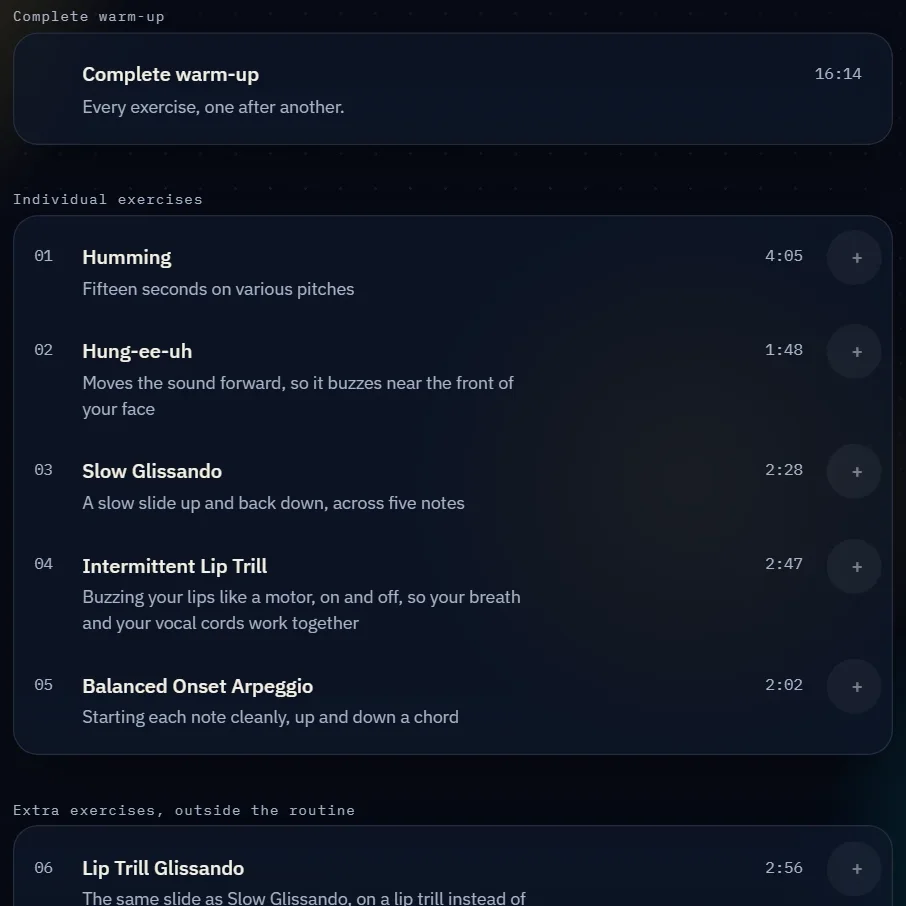
Vocal Fit: My recorded vocal conditioning routine, to sing along with

Build vocal health, condition your voice and reinforce healthy technique by singing along with me. My written instructions for each exercise appear on screen as it plays.

Vocal Fit is designed to help get your voice into shape at any age. Press play and sing along with me through the complete routine, or work one exercise at a time. As each exercise plays, you see how to do it, what it builds and what to focus on.

  • 18 recordings: the complete routine, the core five exercises and the extra exercises, in a low and a high range
  • My instructions on screen for every exercise, plus a printable PDF
  • Adjustments for maturing voices, and your own exercise list that follows you from laptop to phone

Sold on its own for $20. Included in both plans.

Plays online, so you need an internet connection. The recordings stream and cannot be downloaded.

More about Vocal Fit

Vocal Fit is my vocal conditioning routine. It is there to build vocal health and conditioning; to understand, develop and reinforce foundational, healthy vocal technique; and to warm you up before a rehearsal or a performance. As each exercise plays, my written instructions for it appear on screen: how to do it, what it builds, and what to focus on. A printable PDF of the instructions comes with it too.

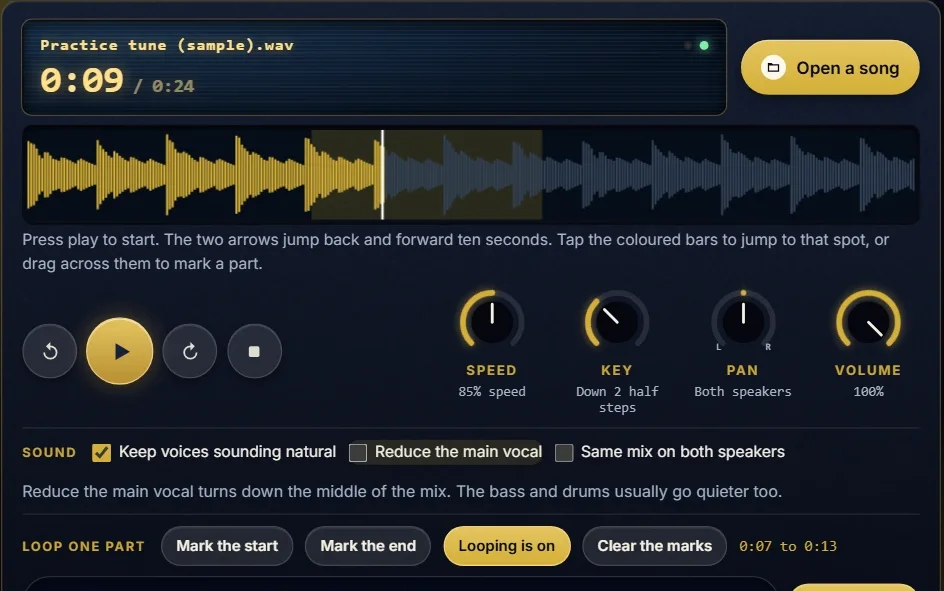
A real screen from the Song Practice Player. Tap or click to enlarge.

Read the video’s words

Love the song but need a different key, or more time with a tricky phrase? Make your recording fit your practice with Song Practice Player. Change the key while keeping the pace, or slow things down without changing the key. Loop the passage you want to work on so it comes back while you stay with the music. Save it by name, ready to return to. Song Practice Player is included in the Online Voice Studio. Subscribe and make your next song practice your own. (Narrated by Ted.)

Singing No microphone needed

Song Practice Player: Change a song’s speed and key, and loop the hard parts

Learn a song at a speed and in a key that work for your voice, and stay with the hard passage until it is secure.

Open an audio file of the song from your phone or computer. Slow the hard part down, move the key to fit your voice, and repeat that passage until it feels secure.

  • Speed from 50% to 120%, and the key up or down 6 half steps
  • Drag across the wave to loop a passage, then name it and keep it, up to 12 per song
  • Turn down the lead vocal to sing along; your settings follow you to any device

You bring your own recording. It plays from your device and is never uploaded.

More about Song Practice Player

You can also turn one side of the stereo mix down, or reduce the lead vocal to sing along karaoke style. Reducing the lead vocal lowers whatever sits in the center of the mix, so the bass and drums may get quieter too, and a voice off to one side only fades a little. Your settings follow your account when you open the same file again.

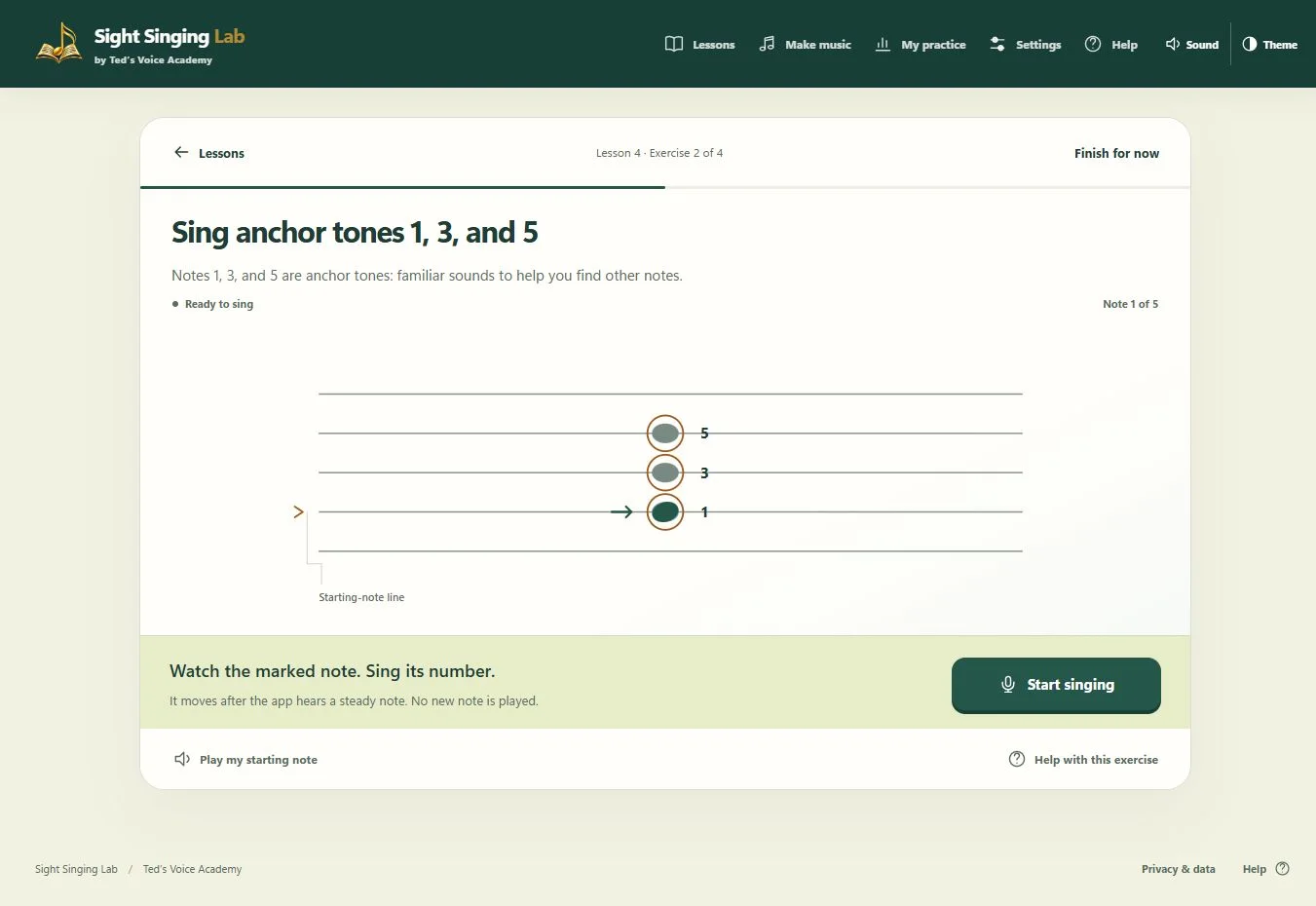
A real screen from Sight Singing Lab. Tap or click to enlarge.

Read the video’s words

Always wanted to read music, but those dots and lines feel like another language? Sight Singing Lab begins with sounds you can sing, without a new vocabulary of syllables to learn first. You build on musical relationships, learning to hear where the next note belongs, even when the melody jumps. [Six-second musical illustration] And if something doesn’t click, there’s a smaller step to practice. Build from simple sounds to rhythms and short melodies, at your own pace. Start finding your own way through the music. Explore Sight Singing Lab inside the Online Voice Studio. (Narrated by Ted.)

Singing Microphone optional

Sight Singing Lab: A four-volume course in reading music and singing it

Learn to read music, so you can learn a part from the page on your own without waiting for a recording or a piano.

Learn to read music and sing it, with The Anchor Tone Sight-Singing Method by Ted Chamberlain. Volume 1 starts with notes that feel easy. Volumes 2 to 4 take you through keys, minor keys and chords, and the scores you get handed in a choir, a hymnal or a solo song.

  • 79 lessons in four volumes, from easy notes to reading your part in a full choral score
  • Optional microphone checks, and you can sing your own part while the other parts play
  • Short knowledge checks that link back to the lesson, and a certificate when you finish a volume

Your place is saved to your account, so you can pick up on any device.

More about Sight Singing Lab

You learn three anchor tones: 1, the home note of the key, and 3 and 5, two notes that sound settled with it. Then you learn the notes beside them, so every new note connects to one you already know. The app chooses notes that suit your voice. Practice with the microphone for automatic checks, or follow the route that works without one. Your recordings are never uploaded. In Volumes 2 to 4 you choose your clef and your part, and a labelled Score map shows what each marking on the page means.

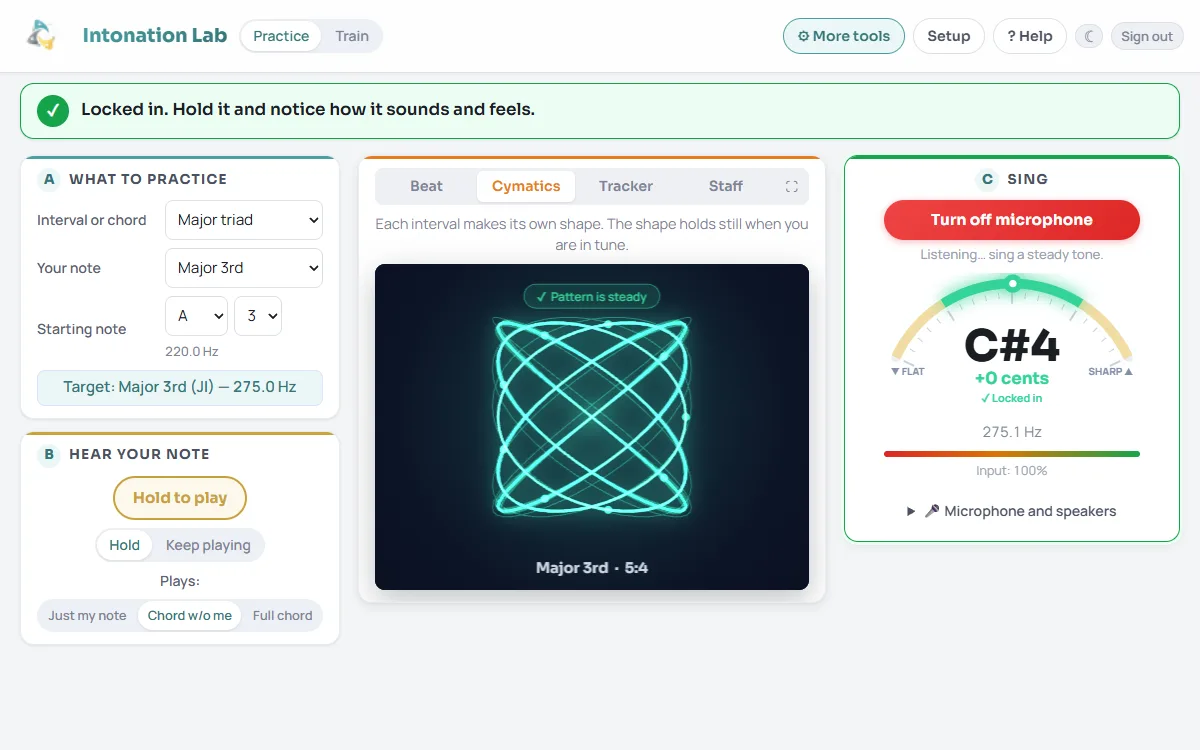
A real screen from Intonation Lab. Tap or click to enlarge.

Read the video’s words

You can practice the skills behind singing in tune. Start with matching the note you hear. With Pitch Matcher, choose a note, then sing or hum it. Its live display shows how close you are, so you can adjust. Dial Match lets you practice hearing a match without having to sing. For a cappella harmony, Intonation Lab helps you discover a finer level of tuning. Learn where your note fits in an interval or chord, and what to listen for and feel as it comes into tune. Through 52 guided exercises, practice recognizing that sound and feeling, and finding that precise tuning again. Start with free Pitch Matcher, or explore Intonation Lab, both through the Online Voice Studio. (Narrated by Ted.)

Singing Uses your microphone

Intonation Lab: Ear training for tuning your part in harmony

Learn to hear and sing the finest level of tuning, where a chord locks and rings. See exactly how sharp or flat you are against pure harmony (just intonation).

My ear training program for singing in tune. Sing an interval (the step from one note to another) or your note in a chord, and see how far sharp or flat you were, in cents (hundredths of a half step), on every attempt.

  • 13 intervals, 16 chord types and 52 structured exercises across four accuracy levels, with a short lesson for each interval
  • See the beating: a ring that wobbles at the real beat rate and settles when you are in tune
  • 13 reference sounds, a drone, and a back-to-back comparison of pure tuning with piano tuning

Sold on its own for $99.99 for one singer. Yours for as long as your membership runs.

Your training progress stays in the browser you use. Wear headphones when you hear your own voice through the app. Coaching tips are chosen from your pitch readings.

More about Intonation Lab

It has a drone (a steady held note) to sing against, the notes on a staff and a keyboard, a scrolling pitch tracker, coaching tips based on your pitch readings, and a recorder that keeps your voice and your pitch line so you can listen back (it stays on your device). The side-by-side comparison of the two tunings lets you hear the difference barbershop and choral singers tune for. It opens on its own site; you enter it from the Studio.

Understand how your voice works

Apps that show what your body and voice are doing when you sing or speak.

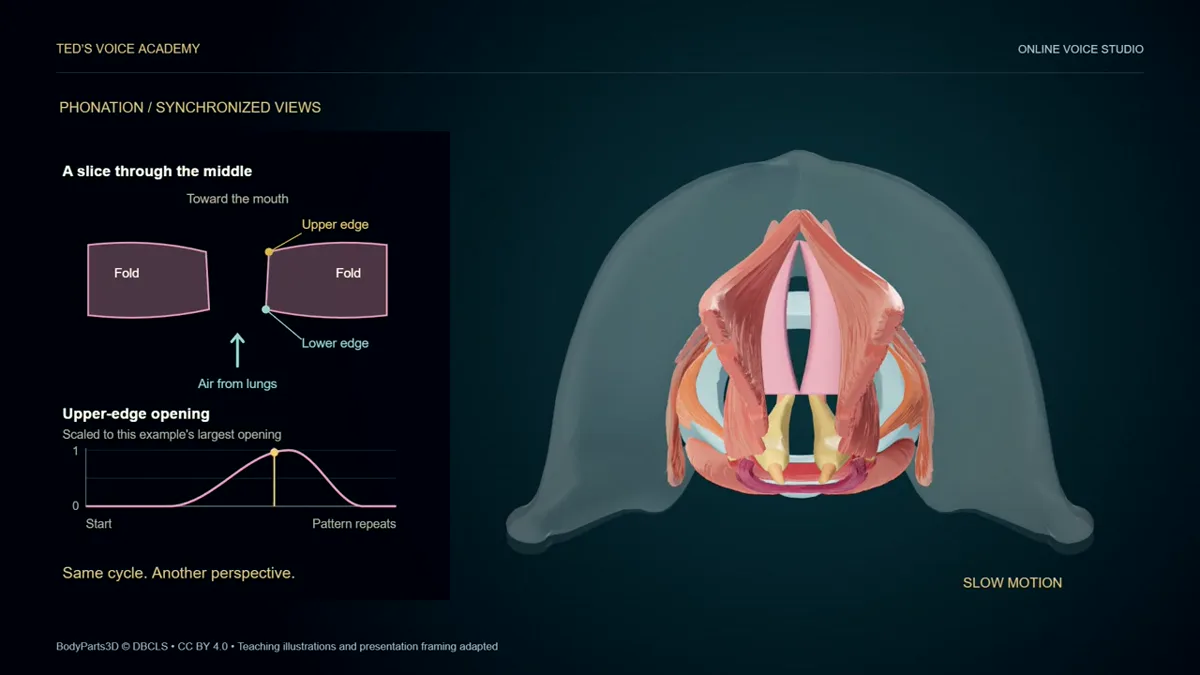
A real screen from Inside the Voice. Tap or click to enlarge. 3D anatomy: BodyParts3D © DBCLS · CC BY 4.0.

Read the video’s words

What changes between chest and head voice? Look inside. Watch the vocal folds move in slow motion. Then see the same movement in cross-section. You control the exploration. Choose a preset and compare the teaching examples. Move a slider and watch the model respond. Pause the movement, then turn the model to inspect the same moment from another angle. Now you can investigate the question together. What changes when we change a vowel? Compare E, AH, and OO. Explore the illustrated tongue, jaw, and lip shapes, and larynx position. Change one thing, turn the model, and look again. [On screen] Keep exploring your voice. Choose your Studio plan below.

Singing & speaking No microphone needed

Inside the Voice: A 3D model of how your body makes your voice, in four parts

See what is really happening inside your body when you sing or speak, so you practice from an accurate picture. Posture, breathing, the vocal folds and resonance, in 3D from real anatomical scans.

The four parts follow the first four pillars, or building blocks, of the Adaptive Voice Framework (AVF), the method from my book. Every claim names the research behind it, and each effect says how strong the evidence is.

  • Posture: move the head, chin, shoulders, pelvis, knees and weight, and see which parts of the voice are affected and why
  • Breath: three ways to breathe in and several ways to control the breath out, played, paused and slowed down
  • Phonation and resonance: the larynx muscle by muscle, guided tours and a quiz; larynx height by singing style, the soft palate, and 12 vowels

A teaching model built from the scans of one real body, refined by medical illustrators. Your own body will differ in the details.

More about Inside the Voice

Body Organization covers standing and sitting, with ready-made postures such as head pushed forward, slouching and shoulders raised. Breath Mechanics compares rib-and-ready, low-and-slow and high-and-lifted breathing, and supported, speaking and long-phrase exhales. Phonation has seven tabs: explore, guided tours, the muscles grouped by what they do, fold movement, a challenge quiz, saved views with a shareable link, and sources. Resonance shows larynx height for classical, musical theater, choral, pop, belt and speech, with the soft palate, throat, jaw, lips and tongue. Turn and zoom the model in every part.

Singing Uses your microphone

Find Your Vocal Transition (Break / Flip): Finds where your voice changes gear, and what kind of change it is

Find where your voice changes gear and what kind of change it is, so you know whether a vowel adjustment or register coordination will help. A dated map shows how it smooths out over time.

It tells apart a switch to a lighter voice, a change that lines up with your vowel, and a change in tone color. A three-second vowel measurement shows the notes where that vowel and your voice meet. Then a one-note exercise lets you move between a full and a light sound and watch it happen.

  • Marks each change on a keyboard and a staff, in plain words
  • Feel the switch on one note, then play your take back with a cursor through the picture
  • Lock in your lowest and highest comfortable notes and save a dated map to your account

Its marks are an estimate to explore. Your voice type and the health of your voice are questions for a teacher or a doctor.

More about Find Your Vocal Transition (Break / Flip)

Before you sing, you learn to hear a change by catching it in an example voice. Results always say “today”, because a voice changes from day to day. Keep the map to compare over time or to bring to a lesson. Only the summary is saved; your audio is not.

Singing No microphone needed

Vowels in Motion: Learn how resonance shapes your voice as you sing higher

Understand how resonance works, the physics behind ease, tone and the passaggio, so vowel modification becomes something you can find and repeat on purpose.

Then practice small vowel changes on one note and through the notes where your voice shifts, and carry them into the words of a song. This is the science behind vowel modification and the passaggio, made something you can hear and see.

“I have studied resonance for decades. Outside an expert teacher’s studio or a top academic voice text, I have never found anything that teaches it like this.”

Ted Chamberlain
  • Hear the separate tones inside one note, and how a vowel changes their balance
  • Hear a tone grow and fade as your pitch moves through a vowel’s resonance
  • Try small vowel changes in your own voice, on one note, through a slide, then in song words

Uses listening examples made by the app, so no microphone is needed. The charts are teaching examples to compare against your own ear.

More about Vowels in Motion

Keep three references beside your practice: a vowel chart by mouth shape, a chart by formants (the frequency zones your throat and mouth make louder, which give each vowel its sound), and a chromatic map that shows where a vowel’s resonance meets the harmonics of the note you sing. Write up to 20 practice notes about what you tried; they stay in the browser you use.

Prepare to speak and perform

Apps for reading aloud, hard conversations, nerves, clear speech and singing in other languages.

Singing & speaking No microphone needed

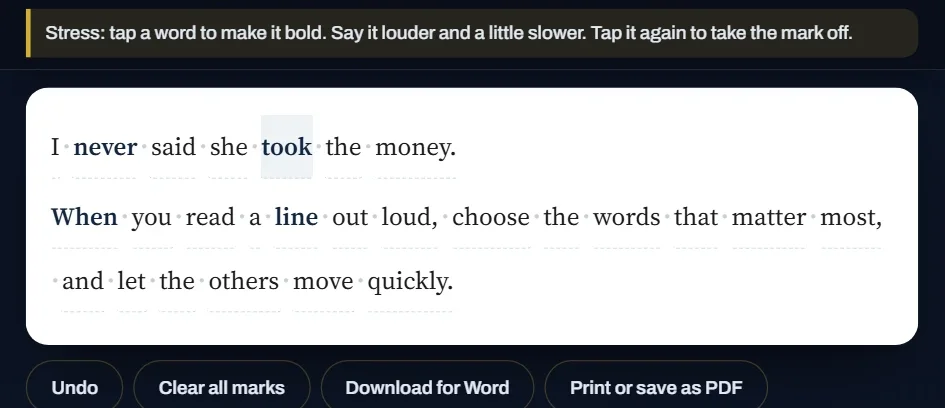
Reading With Meaning: Mark up a script or lyric before you read it aloud

Make the meaning clear to your listeners. Choose which words to stress, where to breathe and pause, and where your pitch rises or falls, then read from your marked copy.

It teaches before you mark: a four-step method, and a sentence that changes meaning with each word you stress. Then choose from 10 marks, including stress, light, rise, fall, lengthen, short pause, long stop and connect, and press a word to place one.

  • 10 marks for words and the gaps between them, plus your own symbol
  • Undo, and your marks are saved in the browser for next time
  • Print it, save it as a PDF, or download it as a Word file

What you paste stays on your device. Read Aloud With Meaning, a separate course, comes with Studio + Courses.

More about Reading With Meaning

Built for anyone reading something aloud that matters: a reading at a service, a presentation, a speech, a story for a group. Read it back with your marks in front of you, so every choice you made is right there on the page as you read. Singers can paste a lyric sheet too and mark the words that carry each thought and where the phrases connect; the written melody and rhythm stay as they are.

Speaking No microphone needed

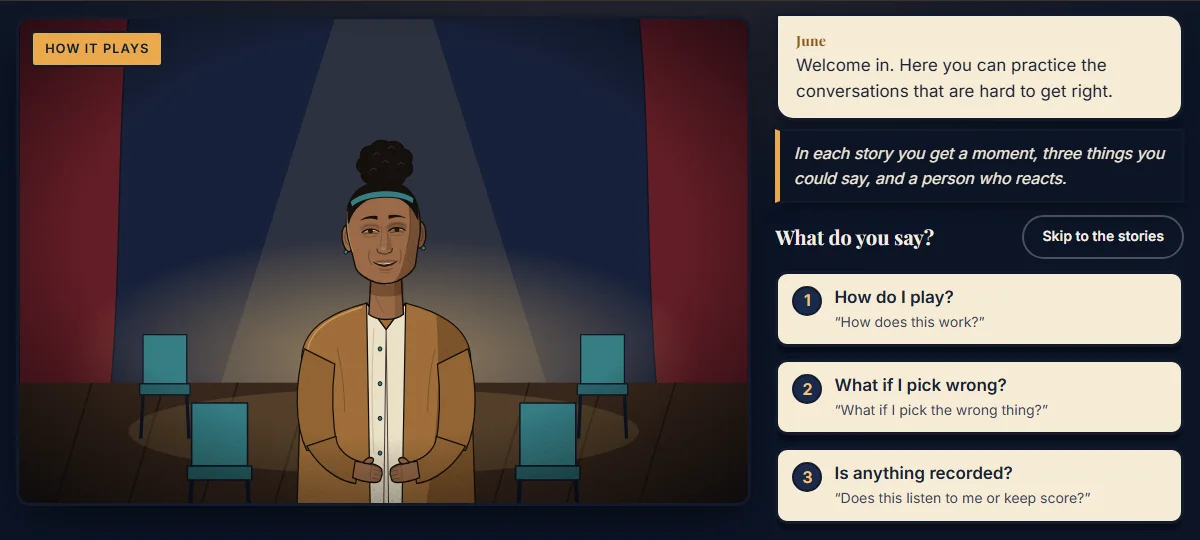
Speaking Under Pressure: Conversation Practice: A role-playing game for difficult conversations

Practice the replies before the real conversation. Try different responses to eight hard moments, see what each one gains and costs, and build judgment you can rely on under pressure.

Each story is drawn as a scene, one moment at a time. You choose one of three replies at each of four decisions, and the other person’s face and posture change with what you said. There are 648 paths, and no reply is right on every count.

  • 8 illustrated stories, 4 decisions in each, 648 paths
  • At the end, see what every reply did for clarity, listening, boundaries and the relationship
  • Replay from any decision, and read the whole conversation back

Fictional characters and businesses. Nothing is recorded, and nothing leaves your device. This conversation practice is in both plans; the course Speaking Under Pressure: Steady Voice, Clear Mind comes with Studio + Courses.

More about Speaking Under Pressure: Conversation Practice

The stories include being interrupted, questions about price, saying no, disagreeing, introducing yourself, repairing a misunderstanding, criticism and an unmet commitment.

Singing & speaking No microphone needed

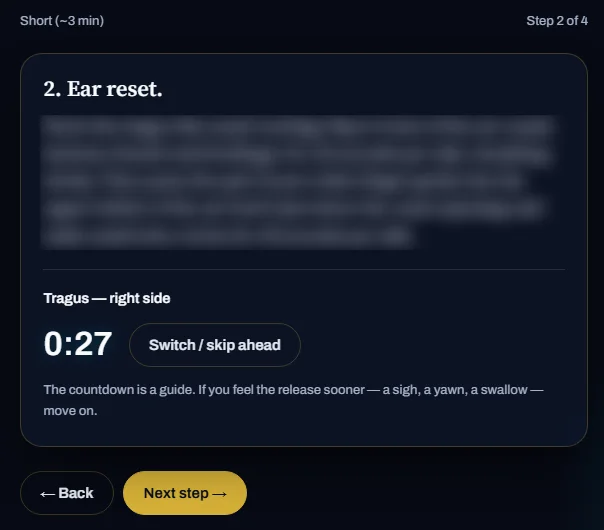
Pre-Show Calm: My routine to calm your body before you perform or speak

Settle your body’s stress response before you sing, perform or speak, so your voice and mind are free to do their work. Guided one step at a time, with timers and counts.

My own three-length routine, in my words. It uses physical techniques such as an ear reset, an eye-gaze release and a long, slow sigh, and ends by carrying that calm into an easy phrase or line.

  • Short (about 3 minutes), Medium (5 to 7) or Full (8 to 10)
  • Timers count down and repeated steps keep your count, so there is less to remember
  • Safety notes one tap away, and a short note under each step that explains why it helps

A guided routine on screen. Nothing is recorded.

More about Pre-Show Calm

One instruction at a time. Timed steps count down for you, repeated steps keep your count, safety notes are one tap away, and you can switch on a short note under each step that explains why it helps.

A real screen from Tongue Twister Lab. Tap or click to enlarge.

Read the video’s words

Want your words to come through clearly in singing or speaking? A tongue twister can be fun. Give that practice a purpose. In Tongue Twister Lab, choose what needs attention, like clear word endings. Open one line with a cue for what to listen for. Keep a few useful lines, including a familiar favorite, on your own practice sheet. Then try a real sentence. Please send the guest list. Bring that same attention to the words you actually need. Tongue Twister Lab is included in both Online Voice Studio plans. Subscribe and make your word practice your own. (Narrated by Ted.)

Singing & speaking No microphone needed

Tongue Twister Lab: 200+ tongue twisters for clearer speech and singing

Make every word clear: sound by sound, ending by ending, with names, numbers and phrasing. Each group comes with a short guide and a tip on how to say each line, and 40 classic tongue twisters sit alongside them.

Groups include lip precision, tongue-tip agility, the S and Z sounds, the two TH sounds, R against L, clear word endings, vowel clarity, long words and stress, numbers and names, and phrasing and expression. Five more groups hold 40 classic tongue twisters, sorted by sound.

  • Tap a line and it fills the screen; your phone stays on while it is propped up
  • Tick the lines you want, mixing classics and exercises, then print a sheet, save it as a Word file or copy it into Google Docs
  • Two versions of the guidance: standard, and youth for ages 14 to 18

You say the lines aloud. Nothing is recorded or scored.

More about Tongue Twister Lab

Each group opens with what to focus on and a short guide. Tap any line to read it full screen, tick the lines you want, then print a sheet, save it as a Word file or copy it into Google Docs.

A real screen from IPA Studio. Tap or click to enlarge.

Read the video’s words

Love the song, but unsure how to say the words? IPA Studio turns your lyrics into a spoken practice reference. Hear the phrase. Then focus on the word you need. Slow it down. Repeat it with time to say it back. Explore unfamiliar sounds through example words, phonetic guides, and mouth pictures where available. Keep your own translations and performance notes beside the words, so pronunciation connects with what you want to express. And download the MP3 to keep practicing beyond the screen. IPA Studio is included in both Online Voice Studio plans. Subscribe and start with your next song. (Narrated by Ted.)

Singing Microphone optional

IPA Studio: Pronounce, understand and learn songs in other languages

Prepare a song in another language on your own: accurate pronunciation, what the words mean, and practice. Paste in your lyrics to start.

IPA, the International Phonetic Alphabet, shows exactly how each word sounds. The IPA Studio lists 36 languages, including Italian, German, French, Spanish, Latin, Russian and Czech. Correct any word with an on-screen symbol keyboard, look up any symbol with a sound and a mouth diagram, and practice with listen-and-repeat. Natural-sounding voices read your lyrics aloud in 34 of them, including regional choices such as American or British English, with a female or male voice.

  • IPA in 36 languages, ready for you to check and correct word by word; hear pronunciation in 34
  • Hear a word, a line or the whole lyric read aloud by a natural-sounding voice, at the speed you choose, and download it as an MP3
  • Word meanings, poetic meaning and a full translation, worked out on your device, in the languages your browser supports

The IPA, the spoken voice and the translations are computer drafts. Translation depends on the languages your browser supports and needs a one-time language download. Latin and Yiddish are there for study, with no spoken audio yet. Translation and other resources cover fewer languages. Spoken recordings stay in your account for 30 days, within a monthly allowance; download the MP3 to keep one. Saved projects stay in the browser where you saved them. You will still want a coach on anything you are performing.

More about IPA Studio

Add notes to any word or phrase. Import a recording of the song and practice a passage with listen-and-repeat, at your speed, with pauses. Record yourself and listen back. Save projects on your device, back them up, and print a practice page.

Price comparison

A year of The Studio plan ($99.90) costs less than one private lesson ($100)

One lesson with me is $100. A full year of The Studio plan is $99.90 (ten months at $9.99, with two months free), and it is open every day of that year.

  • A seat in the Intonation Lab$99.99one-time, for one singer
  • Vocal Fit, my recorded warm-up$20one-time
  • The other practice tools, the IPA Studio and the library: many with nothing like them anywhere elseOnly in the Studio
  • A year of The Studio plan: every tool and the library, plus Vocal Fit and a Lab seat for as long as you are a member$99.90per year
  • A year of Studio + Courses: everything above, plus 20 courses$199.90per year

The Studio + Courses plan

The Studio + Courses plan adds 20 online courses

Studio + Courses adds 20 Master Your Voice courses for singers and speakers: step-by-step lessons, practice tasks, quizzes that explain each answer and, in many courses, a practice plan you build as you go. New courses are included as they are published.

For singers 10 courses

  • AVF Intermediate Singing
  • Expand Your Range Without Strain
  • Registers in Plain Words
  • Sing in Tune
  • Sing It Like You Mean It
  • Singing for Worship and Church Music
  • Singing Pop, Rock and Musical Theatre
  • Steady on Stage
  • Vocal Health Essentials for Singers Free to everyone
  • Your Voice After 50

For speakers 6 courses

  • Off the Cuff
  • Read Aloud With Meaning
  • Sound Like a Leader
  • Speaking Under Pressure
  • Telling a Story Out Loud
  • The Speaker's Voice

For singers and speakers 4 courses

  • Be Heard Without Shouting
  • Microphone Basics for Singers and Speakers
  • Practice Smarter
  • Your Adaptive Voice

Courses are open for as long as your Studio + Courses membership runs. Some courses share a topic with a Studio tool: the tools are in both plans, and the courses come with Studio + Courses. Courses are also sold outright, one at a time, if you would rather own one than rent them all.

Ted Chamberlain, founder of Ted’s Voice Academy.

About Ted Chamberlain, who built the Studio

“Technique exists to serve expression.”

I have taught singers and speakers since 1988. The Studio brings together the tools and resources I have built or chosen for my own students, so you can explore, rehearse and build your voice whenever you practice, whether or not you take lessons.

Why I built these tools. Each one is something that would have been of tremendous value to me along my own learning journeys over the years. They also give my students more ways to keep learning between lessons and beyond, at their own pace and on their own terms. They make a strong companion to one-on-one coaching, a speaking group like Toastmasters, singing in a choir, and the other ways you are already learning.

Ted Chamberlain · Founder, Ted’s Voice Academy, Lacey, Washington

  • Teaching voice since 1988
  • Over 1,000 students coached
  • Earned National Board Certification in Music (2005)
  • Author, The Adaptive Voice Framework
  • Member, National Association of Teachers of Singing (NATS)
  • 2025 Lacey South Sound Chamber Entrepreneur of the Year
★★★★★
Ted is an incredible voice coach! He meets you exactly where you are in your vocal journey and tailors each lesson to focus on the specific areas you want to improve. He’s not only supportive and encouraging, but also extremely knowledgeable. I highly recommend working with him!
Helen A, on Google
★★★★★
Ted has been incredibly helpful to my singing, both as a choral director and as a coach. He is a fantastic teacher, and has a wide array of techniques and deep knowledge. His superpower (IMHO) is the ability to tailor the coaching to each student.
Gideon Shavit, on Google
★★★★★
Highly recommend for any professional needing to perfect verbal communication in person, over video or on the phone.
Dr. Trevor Marum, on Google

Those reviews are for my coaching. The Studio is the material behind it.

Membership plans

Choose your plan

Both plans open every tool and the whole library. Studio + Courses adds the courses. Cancel any time, and keep access through the period you paid for.

The Studio plan

$9.99/ month

Every tool, Vocal Fit and the library
Studio + Courses

$19.99/ month

All of that, plus 20 courses

Tools, training and library

The Studio plan

Every practice tool, Vocal Fit and the whole library.

Choose this to practice with every tool, recording and library item.

$9.99/ month

About 33¢ a day

Renews every month at $9.99 until you cancel.

  • Every practice tool on this page
  • Vocal Fit, my recorded warm-up
  • The library: 60+ songbooks, 50+ warm-ups and teaching plans, handouts
  • Reading With Meaning, Speaking Under Pressure: Conversation Practice, and 35+ scripts to read aloud
  • The Tongue Twister Lab and the IPA Studio
  • A seat in the Intonation Lab while you are a member
  • 20% off the PASS Profile, Riser Chart, Intonation Lab seats, workshops, and AVF books bought at my studio

Everything, plus the courses

Studio + Courses

The whole Studio, with 20 guided courses alongside it.

Choose this to add step-by-step courses that teach a whole topic.

$19.99/ month

About 66¢ a day

Renews every month at $19.99 until you cancel.

  • Everything in The Studio plan
  • 20 Master Your Voice courses, for singers and speakers
  • Step-by-step course lessons, practice tasks and quizzes
  • New courses included as they are published
  • Courses open while your membership runs

Your price never goes up while you stay a member. Join at today’s price and keep it, while I keep adding to the Studio.

30-day money-back promise. If the Studio is not right for you, press Refund my first payment in the Studio within 30 days. Your full first payment goes back to your card automatically.

Secure checkout through Stripe. After you pay, sign in at members.tedsvoiceacademy.com with the email you paid with; I send you a sign-in link. No password to set.

★★★★★ 38 five-star Google reviews of my coaching. The Studio is the material behind it.

Already taking lessons with me? A monthly lesson plan or a lesson package already includes Studio + Courses at no extra charge. A 5 lesson package covers one month, a 10 lesson package three months, and a 20 lesson package six months, counted from the day you buy it. Open your Studio.

The membership is the shared material. Your lesson summaries and the exercises I make just for you come with lessons.

Want lessons too? Book the free 15‑minute call

Getting started

A suggested first week for singers and for speakers

A simple plan for your first few days. Choose what fits; there is no required order.

A first week for singers

  1. Day 1. Do a first warm-up from the “Start here” shelf, or build a 10-minute routine in Vocalise Studio.
  2. Day 2. Open the song you are learning in the Song Practice Player, slow the hard part down and keep it as a named part.
  3. Day 3. Find where your voice changes gears with Find Your Vocal Transition, and save the map.
  4. Day 4 and after. Follow my recorded Vocal Fit warm-up, then return to your song.

A first week for speakers

  1. Day 1. Build a 10-minute speaking routine in Vocalise Studio.
  2. Day 2. Paste something you will read aloud into Reading With Meaning and mark it.
  3. Day 3. Read one of the 35+ practice scripts, or play a story in Speaking Under Pressure: Conversation Practice.
  4. Before your next talk. Step through Pre-Show Calm.

Ways to use the Studio each week

  • A new song to learn: the Song Practice Player, the IPA Studio and 60+ songbooks
  • Something to read or say this week: Reading With Meaning, the scripts and Pre-Show Calm
  • Today’s practice: Vocalise Studio, Vocal Fit and the warm-up shelves
  • Something new: I add material most weeks, and the Studio’s “What’s new” page lists it.

Added recently: IPA Studio Oct 28 · Sight Singing Lab Oct 25 · Tongue Twister Lab Oct 22 · Vowels in Motion Oct 17 · Inside the Voice Oct 15. Every new tool is included in both plans.

The Studio Library

The Studio Library: sheet music, scripts, warm-ups and handouts

Sit down to practice with music to sing, scripts to read and a warm-up for the kind of day you are having.

60+

Songbooks and songs

Public domain sheet music (free of copyright) to read on screen or print: more than 7,000 pages, sorted by the voice each book was published for.

35+

Scripts to read aloud

Each built around one speaking skill: introducing yourself, explaining something, making a case, telling a story, pace and pauses.

50+

Warm-ups and teaching plans

On shelves named for what you need: Start here, Everyday warm-ups, For a particular kind of day (mornings, recovery, auditions, performance day), For one voice type or style, For a chorus, and more.

170+

Items on 14 shelves

Warm-ups, handouts, scripts and music. I add to it most weeks, and everything I add is included.

Also included: five more tools and every past newsletter

Tools for vocal tone, tuning and group listening, and every past issue of my newsletter.

Swipe to see all six.

Singing Microphone optional

Voice Unity App: A five-step course in the tones inside your voice

Record three seconds of your singing and hear each tone inside it played back on its own. Then learn to move those tones, and why some notes are harder than others.

More about Voice Unity App

Five steps: hear the tones, hear them in your voice, move them with your vowel, understand why (a frequency ladder by voice type and style, from classical and musical theater to belt, country and barbershop), and practice with four tools, including a vowel plan for climbing and a game for finding the ring. It also has a live meter with a 3-minute replay, a teacher demo menu, a searchable guide and colour-blind-safe themes.

Singing & speaking Uses your microphone

Voice Timbre: Four voice tests: timbre, range, the notes you use most, and where your voice changes

Find how bright or dark your voice is, your range, your tessitura and your passaggio, each from a short test.

More about Voice Timbre

Four short tests from your microphone. Hold one vowel three times and get your timbre on a scale from 1 (brightest) to 10 (darkest). Slide down and up to find your lowest and highest notes. Sing a song or read a short passage to find your tessitura, the notes you use most. Do four slow slides to find your passaggio, the place where the voice changes gear. Every result says in plain words what the number means, and you can download a two-page report. These are estimates to explore; they do not decide your voice type.

Read the video’s words

When you're asked to blend, do you know what to change? Explore a virtual quartet between rehearsals. Hear a pair. Change one vowel while the other singer holds steady. Then hear the whole quartet. Replay and experiment without gathering four singers. Ensemble Unity is included in the Online Voice Studio. Subscribe and start exploring. (Narrated by Ted.)

Singing No microphone needed

Ensemble Unity: A listening game for matching a quartet

Four singers hold a chord, and you adjust one of them until the chord sounds as one: matching vowels, tuning, balance and timing.

More about Ensemble Unity

43 lessons across four skills, each with a short tutorial, plus mixed challenges. Choose men’s, women’s or mixed voices. The voices are made from real singers’ recordings. It plays examples for you to compare; it does not use your microphone.

Read the video’s words

That moment when a chord rings. You want to help make it happen. Rehearsal Ring Meter connects what you hear with things you can practice, alone and together. See the overtones in your sound. Explore your own vocal buzz. Learn to hear ringing harmony. Then work on where your note fits. Hear it against a lower reference, and keep singing as the higher guide fades. Practice holding your place without a note to copy. With your group, watch whether the key is drifting as you sing. Rehearsal Ring Meter. Included in the Online Voice Studio. Subscribe and explore. (Narrated by Ted.)

Singing Uses your microphone

Rehearsal Ring Meter: Five live screens for tuning, alone or with a quartet or chorus

Screens large enough to read from across a rehearsal room: how well the parts sing as one, whether the key has drifted, a lock-in tuner, every overtone drawn live, and seven lessons.

More about Rehearsal Ring Meter

Set it for one singer, a quartet or a chorus. Unity shows how tightly each part sings as one voice. Drift shows whether the group has kept the key since the pitch pipe. Lock is a tuner with four skill levels, from ±20 cents down to ±5; with a drone it tells you to lift or ease down. Ring draws the overtones as you sing. Learn has seven lessons that score each session and chart your progress. Mark the start and end of a song for a summary card. Nothing is recorded unless you press Record a sample, which saves eight seconds to your own device.

Singing Microphone optional

Pitch Matcher: Practice singing the note you hear

Sing a note and watch a staff and a meter show how close you are, or train your ear by turning a dial until two notes stop beating against each other.

Also free for everyone: try Pitch Matcher now
More about Pitch Matcher

In Voice Match, choose a note on the keyboard, sing it, and see your pitch on a grand staff with a cents meter (green, yellow or red). In Dial Match, a second note starts out of tune and you turn a dial until it matches, listening for the wobble to slow and stop. Five sounds, an adjustable keyboard range, and charts of your accuracy over time, kept on your device.

Singing & speaking

Past newsletters: Every issue of my monthly newsletter

Members can read every issue of my free monthly newsletter in the Studio, newest first, with no mailing-list sign-up.

More about Past newsletters

Each issue has one practical thing to work on. The newsletter itself is free, and you can sign up for it further down this page, under “Try something free today.”

Members also get 20% off my other products: the PASS Profile (my communication assessment with a personal report), the Riser Chart (an app for arranging singers on the risers), Intonation Lab seats bought outright, my workshops, and my AVF books when you buy them at my studio. Lessons and coaching are not discounted.

Before you join

Common questions about the membership

Ask me anything at ted@tedsvoiceacademy.com.

What happens after I pay?

You pay through Stripe’s secure checkout. Then you sign in at members.tedsvoiceacademy.com with the email address you paid with: type it in and I send you a sign-in link. There is no password to set, and it works on your phone, tablet and computer.

Can I cancel?

Yes, any time. In the Studio, press the “Manage my subscription” button, then Cancel. You keep access through the period you have already paid for, and nothing renews after that.

Is there a free trial?

There is no free trial, and your first 30 days are covered: if the Studio is not right for you, press Refund my first payment in the Studio within 30 days, and your first payment comes back to your card in full. You can also cancel any time before it renews. To try something free first, take the click-through tour of the real Studio, use Pitch Matcher, take my free course Vocal Health Essentials for Singers, or join my monthly newsletter.

Where do I start?

Bring one goal or question. Build a routine in Vocalise Studio, open the song you are learning in the Song Practice Player, or mark a script in Reading With Meaning. There is no required path through the whole collection; “Your first week” above has two suggestions.

Where can I find free sheet music to sing?

The Online Voice Studio holds 60+ public domain songbooks and single songs as PDFs you can read on a screen or print, more than 7,000 pages in all. They are sorted by the voice each book was published for. Public domain means the copyright has expired and the music is free to use.

What tongue twisters actually help my diction?

The Tongue Twister Lab holds 200+ lines. Sixteen groups each work one specific thing: lip precision, tongue-tip agility, the two TH sounds, R against L, clear word endings, numbers and names. Five more groups hold 40 classic tongue twisters, sorted by sound. Each group comes with a short guide, in a standard version and a youth version for ages 14 to 18; the lines are the same in both.

How do I practice reading out loud?

There are 35+ practice scripts, each one built around a single speaking skill: introducing yourself, explaining something, making a case, telling a story, which word matters, pace and pauses. Reading With Meaning lets you mark stress, breaths and pauses on your own text before you read it aloud.

Which vocal warm-up should I do today?

50+ warm-ups and handouts, grouped by the kind of day you are having: a first warm-up, everyday use, a tired voice or an early call, a whole chorus, and one particular voice type or style. Vocalise Studio can also build a routine for your goal and the minutes you have.

Do I need to be able to sing already?

No. There is a shelf for a first warm-up, written for somebody who has never done one, and every item in the library has a short description, so you know what it is before you open it. Many of the warm-ups also show how many minutes they take.

I am a speaker, not a singer. Is this for me?

Yes. Reading With Meaning, Speaking Under Pressure: Conversation Practice, the 35+ practice scripts and the Tongue Twister Lab were built with speakers in mind, and Pre-Show Calm and Vocalise Studio serve speakers and singers alike. Warm-ups work the same voice either way.

Can I use it with my chorus, quartet or students?

For your own practice and your own performing, use all of it, and print a sheet and mark it up. If you sing in a chorus or a quartet, the group warm-up is there to run with your own group. The files stay inside the Studio, so each singer, speaker or student who wants the tools needs a membership of their own. For group ear training, I sell group licenses for the Intonation Lab, from a quartet up to a large group.

Does it work on a phone?

Yes, on a phone, tablet or computer, in your web browser. There is nothing to install. Some tools save your work to your account and some only in the browser you use; each tool’s own Help in the Studio says which.

Do the tools use my microphone?

Some do, to hear you sing and show what they hear, and your browser asks your permission first. Many need no microphone at all. Every tool on this page says whether it uses one.

Is my voice recorded or uploaded?

The tools that listen check your voice on your own device. Some let you record and replay yourself, and each app explains what it keeps. Songs you open in the Song Practice Player play from your device and are never uploaded.

Can I buy a course instead of subscribing?

Yes. Courses are also sold outright, one at a time, and buying keeps that course with no time limit. Studio + Courses opens every course and all the tools for as long as your membership runs.

Is this the same as lessons with you?

No. This is the material. Lessons are the hour where I listen to your voice and tell you what I hear. If you want that, the free 15-minute call is where you start.

Is new material included in my plan?

Yes. New tools, warm-ups and library material are included in both plans, and new courses are included in Studio + Courses. I add to the Studio most weeks, and your price stays the same for as long as you stay a member.

Where do I sign in?

At members.tedsvoiceacademy.com. Type your email and I send you a sign-in link. There is no password to remember.
Join the Online Voice Studio

Your tools, warm-ups and library are ready as soon as you sign in.

Your price stays the same while you are a member. Full refund within 30 days if it is not right for you. Cancel any time.