
Voice Glossary
The words singers and speakers meet in a lesson, a rehearsal or a book, explained in plain language. Every entry shows a short answer straight away. Open one and you get the full definition, how to say it, and where to read more.
104 terms
Nothing here matches that. Try a shorter word, or clear the search to see all 104 terms.
A
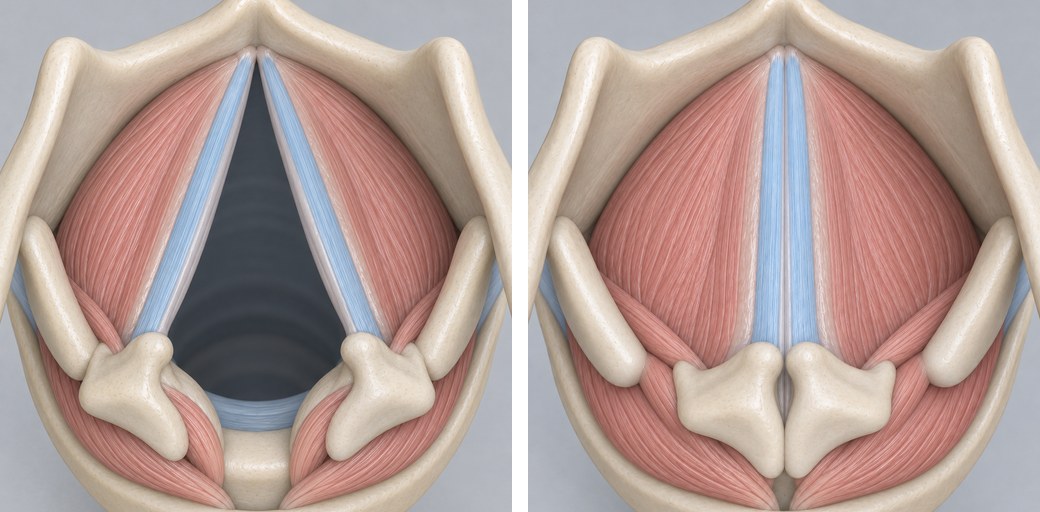
Abduction The opening of your vocal folds, letting air through without making sound.
The opening of the vocal folds, allowing airflow without phonation. The opposite of adduction.
Adaptive Voice Framework My teaching system: function stays constant, style is choice.
An integrative pedagogical system combining anatomy, acoustics, neuroscience, and artistry into one flexible model of healthy vocal function. Core premise: Function stays constant; style is choice.
Adduction How firmly your vocal folds come together to make sound.
The closing or coming together of the vocal folds. The degree of adduction affects vocal quality, ranging from breathy (incomplete closure) to balanced to pressed (excessive closure).
Aerodynamic-Myoelastic Theory Singing The explanation of why vocal folds vibrate: air pressure meets elastic tissue.
The scientific explanation of vocal fold vibration resulting from the interaction between airflow (aerodynamic) and tissue elasticity (myoelastic). Air pressure from the lungs sets elastic vocal fold tissue into self-sustaining oscillation.
Appoggio /apˈpɔddʒo/ ah-POH-joh Singing The Italian term for breath in balance, holding pressure steady without strain.
Traditional Italian term for the coordinated balance between inspiratory and expiratory forces that stabilizes subglottal pressure without excess tension. AVF redefines it as dynamic pressure–flow equilibrium.
Articulation The shaping of sound into speech by your tongue, lips, jaw and soft palate.
The shaping of sound into speech through movements of the tongue, lips, jaw, and soft palate. In AVF, articulation is viewed as acoustic refinement that should enhance rather than obstruct resonance.
Aryepiglottic narrowing Singing A smaller inlet just above your vocal folds.
Smaller inlet area at aryepiglottic level.
Worth being clear about: Cannot be confirmed by facial buzz.
Arytenoid Cartilages /ˌærɪˈtiːnɔɪd/ arr-ih-TEE-noyd Singing The paired cartilages your vocal folds attach to, which swivel to open and close them.
Paired pyramid-shaped cartilages in the larynx that sit atop the cricoid cartilage. The vocal folds attach to the arytenoids, which rotate and slide to open and close the glottis.
Aspirate Onset Starting a note with air first, so a soft "h" arrives before the tone.
A phonation initiation where airflow begins before vocal fold closure, creating a breathy "h" sound before the tone. Associated with gentleness, vulnerability, or stylistic choice in pop/folk singing.
Autonomic Nervous System The part of your nervous system running the things you do not consciously control.
The part of the nervous system responsible for involuntary bodily functions including heart rate, digestion, and respiration. Includes sympathetic (mobilization/arousal) and parasympathetic (restoration/calm) branches that directly influence vocal readiness and phonation quality.
B
Balanced Onset Starting a note with air and closure arriving together — clean, and the one to come back to.
A phonation initiation where airflow and vocal fold closure begin simultaneously, producing a clean tone without breathiness or glottal attack. Considered the most efficient and versatile onset type.
Balancing Point The point where your breath and your tone settle together.
Temporary AVF combination for current task.
Worth being clear about: Not one location or fixed ideal.
Belt/Belting Singing Carrying a strong, speech-like chest quality up into your higher range.
A vocal registration strategy common in musical theatre, pop, and contemporary commercial music characterized by extended chest voice (M1) coordination into higher pitch range with specific acoustic modifications including elevated larynx, pharyngeal narrowing, and strong twang. Produces bright, powerful, speech-like quality.
Body Organization The first of the Five Pillars: how your body is set up so everything else can work.
One of AVF's Five Core Pillars. The integrated alignment and physical readiness that allow efficient movement, coordinated breath, and unrestricted vibration. Not static posture but dynamic responsiveness.

Breath Mechanics The second of the Five Pillars: the engine that powers your voice.
One of AVF's Five Core Pillars. The coordinated management of inhalation and exhalation that maintains steady, responsive airflow and stable subglottal pressure. Efficient breath management balances power with release.
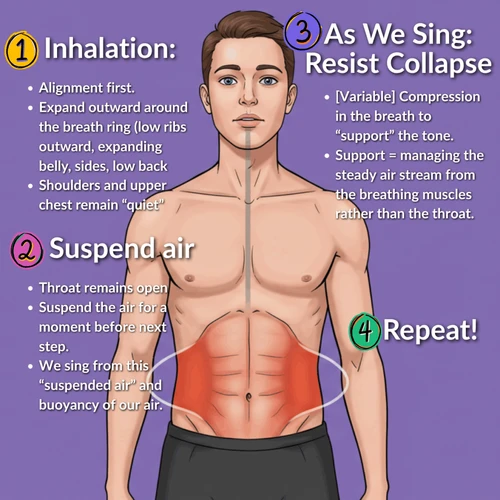
Breathy Phonation A tone with audible air in it, because the folds are not closing completely.
Voice quality characterized by audible air escape during phonation, resulting from incomplete vocal fold closure. Can be stylistic choice or indication of technical imbalance.
C
Carry Whether your voice survives distance and competing noise.
Perceptual survival across distance or competition.
Worth being clear about: Not one acoustic measure.
Chest Voice The fuller, lower part of your range.
Colloquial term for lower-range phonation characterized by full vocal fold vibration (thick folds), strong lower harmonics, and vibratory sensation in the chest. Mechanistically corresponds to M1 (modal voice) with specific acoustic characteristics.
Chiaroscuro /kjaroˈskuːro/ kyah-roh-SKOO-roh Singing The classical ideal of a tone that is bright and warm at the same time.
Italian term meaning "light-dark," describing the balanced vocal timbre in classical singing that combines brightness (chiaro) with warmth/depth (oscuro). Achieved through specific resonance strategies including lowered larynx and balanced formant tuning.
Closure Quotient Singing A measure of how much of each vibration your folds spend closed.
A measure of vocal fold closure during the vibratory cycle, expressed as the percentage of time the folds are closed. Higher CQ indicates firmer closure; lower CQ indicates breathier phonation.
Co-regulation Speaking Offering a settled, unhurried presence, and what that does for the people listening.
A term borrowed from developmental and clinical work, describing one person's state influencing another's. In adult professional settings the mechanism is not well established; what has been demonstrated between adults is that visible effortful concealment of strain reaches the other person and costs them. As used in this book the term names a practice—offering a settled, unhurried presence—rather than a claim about measurable physiological transfer.
Contemporary Commercial Music Singing The umbrella term for everything that is not classical — pop, rock, gospel, country, musical theatre.
Umbrella term for non-classical vocal styles including pop, rock, R&B, gospel, country, and musical theatre. Characterized by speech-like delivery, amplification use, and often different registration strategies than classical approach.
Cover-Body Theory Singing A model of whether the outer layers or the deeper muscle of your folds is leading the vibration.
Model describing vocal fold vibration in terms of whether outer layers (epithelium and superficial lamina propria—the "cover") or deeper mass (vocalis muscle—the "body") dominates vibration. Useful for understanding registration transitions.
Cricoid Cartilage /ˈkraɪkɔɪd/ KRY-koyd Singing The ring of cartilage at the base of your larynx.
The ring-shaped cartilage forming the base of the larynx, sitting atop the trachea. Provides structural foundation for other laryngeal cartilages.
Cricothyroid /ˌkraɪkoʊˈθaɪrɔɪd/ kry-koh-THY-royd Singing The muscle that lengthens and thins your vocal folds to raise pitch.
Intrinsic laryngeal muscle that lengthens and tenses the vocal folds, primarily responsible for pitch increase. Most active in the upper range, including head voice and falsetto.
D
Diaphragm /ˈdaɪəfræm/ DY-uh-fram The dome-shaped muscle under your lungs that draws air in.
The dome-shaped muscle separating the thoracic and abdominal cavities. Its contraction and descent create negative pressure that draws air into the lungs. Primary muscle of inhalation.
Diction One of the Eight Dials: how clearly and precisely the words come across.
Which sounds you make and how cleanly you make them — the consonants that mark the edges of words, the vowels that carry them, and the endings that go missing first when a line gets hard. In singing it also covers pronouncing another language well enough for a listener who speaks it.
Dorsal Vagal Response Speaking The shutdown state, heard as flat tone and weak sound.
Term from Polyvagal Theory for the shutdown/freeze response, associated in that model with the oldest part of the vagus nerve and triggered by overwhelming threat. Manifests vocally as flat tone, weak phonation, and emotional numbness. See Polyvagal Theory for the status of the underlying model.
Dynamic Equilibrium Balance that keeps moving — the AVF idea that stability comes through adjustment, not stillness.
Continuous balance among muscular, aerodynamic, and acoustic forces that allows flexible vocal control without rigidity. Central AVF principle recognizing that stability comes through adaptive motion, not fixed position.
E
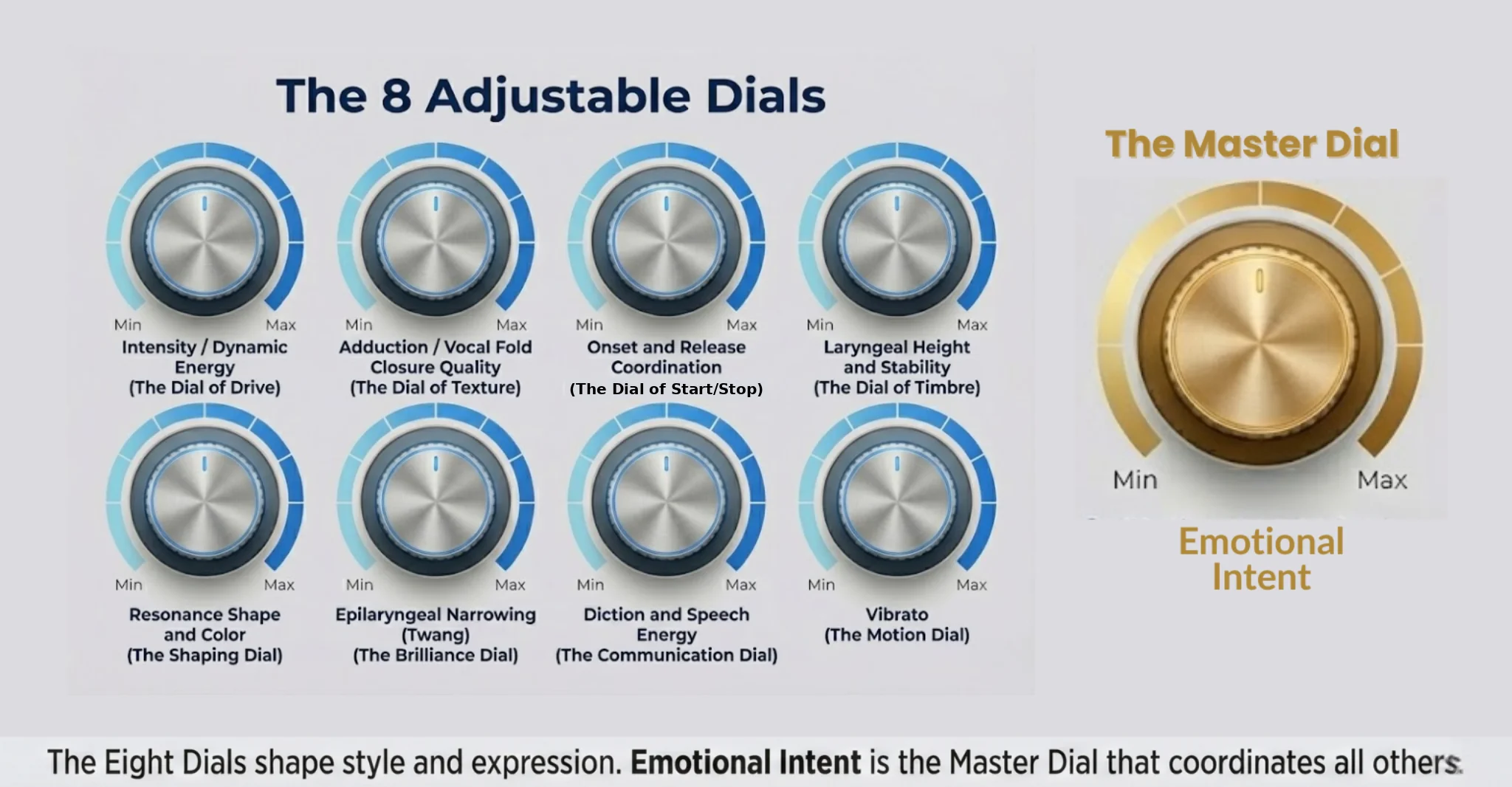
Emotional Intent The Master Dial: what you are actually trying to say, sitting above the other eight.
The Master Dial, above the eight. The authentic emotional state and communicative purpose that organizes all other vocal elements. In AVF, emotion is primary organizer of vocal function, not an overlay.
Entrainment Singing Bodies falling into rhythm together — breath and pulse syncing up when people sing as one.
The synchronization of biological rhythms (breath, heart rate, nervous system state) between individuals, often facilitated through shared sound, resonance, and coordinated movement in ensemble singing.
Epilaryngeal Narrowing A bright, carrying edge made by narrowing the small space just above your vocal folds.
A controllable constriction in the space just above the vocal folds (epilarynx/aryepiglottic sphincter) that clusters upper harmonics, creating increased brilliance and projection. Essential component of belt voice and "ring" in classical singing. Related to but distinct from nasality.
Epilaryngeal tube Singing The short space just above your vocal folds, in acoustic models.
Short lower vocal-tract region above glottis in acoustic models.
Worth being clear about: Boundaries vary by model.
Expression The fifth of the Five Pillars: meaning made audible.
One of AVF's Five Core Pillars. The artistic and communicative integration of emotion, intention, and imagination that animates voice with authenticity and presence. Expression is meaning made audible through coordinated vocal function.
F
False-fold compression Squeezing above your true folds, which is not the target.
Medial or other constriction above true folds.
Worth being clear about: Not default target for easy twang.
Falsetto /fɔːlˈsɛtoʊ/ fawl-SET-oh Singing A light, often breathy upper register with incomplete closure.
Vocal register characterized by light, often breathy quality produced through M2 (light mechanism) with incomplete glottal closure. More prominent in male voices; distinct from reinforced head voice which has firmer closure.
Formant A resonance peak of your vocal tract — what decides which vowel a listener hears.
A resonance peak in the acoustic spectrum created by the vocal tract's filtering of the voice source. The frequencies and amplitudes of formants determine vowel quality and vocal timbre. Formants are numbered (F1, F2, F3, etc.) from lowest to highest frequency.
Worth being clear about: Not a harmonic created by the folds.
Formant Tuning Singing Shaping your vocal tract so its resonances line up with the note you are singing.
The strategic adjustment of vocal tract shape to align formants with harmonics of the fundamental frequency, optimizing acoustic amplification and efficiency. Central to resonance mastery across all styles.
Function Over Form The AVF maxim: healthy function first, style second.
Central AVF maxim stating that technical choices must derive from physiological efficiency first, aesthetic style second. Healthy function is constant; stylistic form is variable choice.
Functional Universality Every healthy voice runs on the same foundations, whatever the style.
AVF principle recognizing that all healthy voices rely on the same physiological and acoustic foundations (the Five Pillars), regardless of style. Stylistic differences emerge from different calibrations of the Eight Dials, not different anatomies.
Fundamental Frequency The rate your vocal folds vibrate — what a listener hears as your pitch.
The lowest frequency in a complex tone, corresponding to the rate of vocal fold vibration. Perceived as the pitch of the voice.
G
Glottal Onset Starting a note with the folds already closed, so it begins with a small click.
Phonation initiation where vocal folds close before airflow begins, creating a slight percussive "click" or "pop" at the start of tone. Can be stylistic device or indication of excessive tension.
Glottis /ˈɡlɒtɪs/ GLOT-iss The space between your vocal folds.
The space between the vocal folds. Opens during breathing and closes during phonation. Adduction brings the folds together, closing the glottis; abduction separates them, opening the glottis.
H
Harmonics Singing The quieter tones sounding above every note, which together make your tone colour.
Frequency components of a complex tone that are integer multiples of the fundamental frequency. The presence and relative strength of different harmonics create vocal timbre. Also called overtones or partials.
Head Voice Singing The lighter, higher part of your range — and a term that means different things for different voices.
A traditional name for a lighter upper-range sound. In most female classical singing, measurements find it is made in Mechanism 2 (M2): longer, thinner folds with less vibrating mass and usually a shorter closed phase. In the middle of the range, some sounds women call head voice are made in a lightened M1. In male voices, may refer to reinforced falsetto (M2 with firmer closure) distinct from breathy falsetto. Term is contextual and requires clarification.
Hyperfunctional Phonation Making sound with more muscular effort than the job needs.
Voice production characterized by excessive muscular effort and tension, often resulting in pressed or strained quality. Opposite of hypofunctional phonation.
Hypofunctional Phonation Making sound with less engagement than the job needs.
Voice production characterized by insufficient muscular engagement, often resulting in breathy or weak quality. Opposite of hyperfunctional phonation.
I
Inertive Reactance Singing The helpful back-pressure your vocal tract returns to the folds, felt as ring or lift.
The supportive acoustic back-pressure created when the vocal tract's resonance reflects energy back toward the vocal folds, assisting their vibration and closure. Responsible for the sensation of "resonant feedback," "ring," or "lift" in efficient phonation. Maximized when formants align optimally with harmonics.
Intelligibility Speaking How much of what you say is actually understood.
Degree to which language is understood.
Worth being clear about: More level does not guarantee it.
Intensity One of the Eight Dials: the drive and energy in your sound.
One of the Eight Dials. The dynamic energy and drive in phonation, controlled through subglottal pressure and flow. Adjustable from gentle/intimate to powerful/commanding.
L
Lamina Propria /ˈlæmɪnə ˈproʊpriə/ LAM-ih-nuh PROH-pree-uh Singing The layered tissue inside each vocal fold that lets it ripple.
The layered connective tissue structure of the vocal folds located between the epithelium (outer layer) and the vocalis muscle. Divided into superficial, intermediate, and deep layers with varying elasticity and stiffness.
Laryngeal Position One of the Eight Dials: how high or low your larynx rides, which darkens or brightens the tone.
One of the Eight Dials. The vertical positioning of the larynx within the throat, adjustable from lowered (creating darker, warmer timbre) to neutral to elevated (creating brighter, more speech-like quality). Position varies naturally with pitch, vowel, and emotion.
Larynx /ˈlærɪŋks/ LAIR-inks The structure in your throat that holds your vocal folds.
The structure in the throat housing the vocal folds and consisting of cartilages, muscles, and connective tissue. Primary organ of phonation.
Legato /lɪˈɡɑːtoʊ/ lih-GAH-toh Singing Moving smoothly from note to note, with no gap between them.
Smooth, connected singing where tones flow seamlessly into one another without breaks or interruptions. Requires coordinated breath, consistent phonation, and careful articulation.
M
Mechanism 1 Singing The thicker-fold setting your lower and middle range runs on.
Laryngeal configuration characterized by thick vocal fold vibration with full glottal closure, typically used in lower and middle pitch ranges. Thyroarytenoid (TA) muscle dominates. Produces richer harmonic content.
Mechanism 2 Singing The thinner-fold setting your upper range runs on.
Laryngeal configuration characterized by thin vocal fold vibration, often with incomplete closure, used primarily in upper pitch range. Cricothyroid (CT) muscle dominates while TA releases. Produces lighter, airier quality with simpler harmonic structure.
Messa di Voce /ˈmessa di ˈvoːtʃe/ MESS-ah dee VOH-cheh Singing Growing a held note louder and then softer again.
Classical vocal exercise involving gradual crescendo from soft to loud and diminuendo back to soft on a single sustained pitch. Develops coordination of breath, phonation, and resonance across dynamic range.
Mixed Voice Singing A coordination where the change between chest and head voice stops being obvious.
Registration coordination blending characteristics of chest voice and head voice. Depending on the singer, a mix may be produced in M1 or in M2. Achieved through balanced engagement of TA and CT muscles. Emphasized in contemporary commercial music for seamless registration transitions.
Mucosal Wave Singing The ripple across the surface of your vocal folds as they vibrate.
The wavelike motion of the vocal fold's superficial layer during vibration, visible through stroboscopy. Healthy mucosal wave indicates proper tissue pliability and efficient phonation.
Muscle Tension Dysphonia A voice problem caused by too much tension rather than by damage to the folds.
Voice disorder characterized by excessive tension in laryngeal and perilaryngeal muscles interfering with normal phonation. Can be primary (no structural pathology) or secondary (compensation for underlying condition).
N
Nasal coupling Opening the passage between your mouth and your nose.
Velopharyngeal opening connects oral and nasal tracts.
Worth being clear about: Creates resonances and antiresonances.
Neuroplasticity Your brain’s ability to rewire — the reason practice changes anything at all.
The brain's ability to reorganize itself by forming new neural connections throughout life. Vocal training relies on neuroplasticity to establish efficient coordination patterns and replace habitual tension.
O
Onset Type One of the Eight Dials: how air and closure meet as a note begins, and how it ends.
One of the Eight Dials. The coordination of airflow and vocal fold closure at phonation initiation. Three primary types: aspirate (breathy), balanced (simultaneous), and glottal (percussive). Shapes initial tone character and emotional impression.
P
Passaggio /paˈsaddʒo/ pah-SAH-joh Singing The place where your voice changes gear.
Italian term meaning "passage," referring to transition zones in the voice where registration shifts occur. Most voices have two primary passaggi (lower and upper) where singers must adjust coordination as pitch changes. Location varies by voice type.

Phonation /foʊˈneɪʃən/ foh-NAY-shun How a note starts and keeps going.
One of AVF's Five Core Pillars. The production of sound through vocal fold vibration, created by balanced oscillation of the folds under aerodynamic pressure and tissue elasticity. Efficient phonation requires coordination of breath pressure, fold closure, and laryngeal stability.
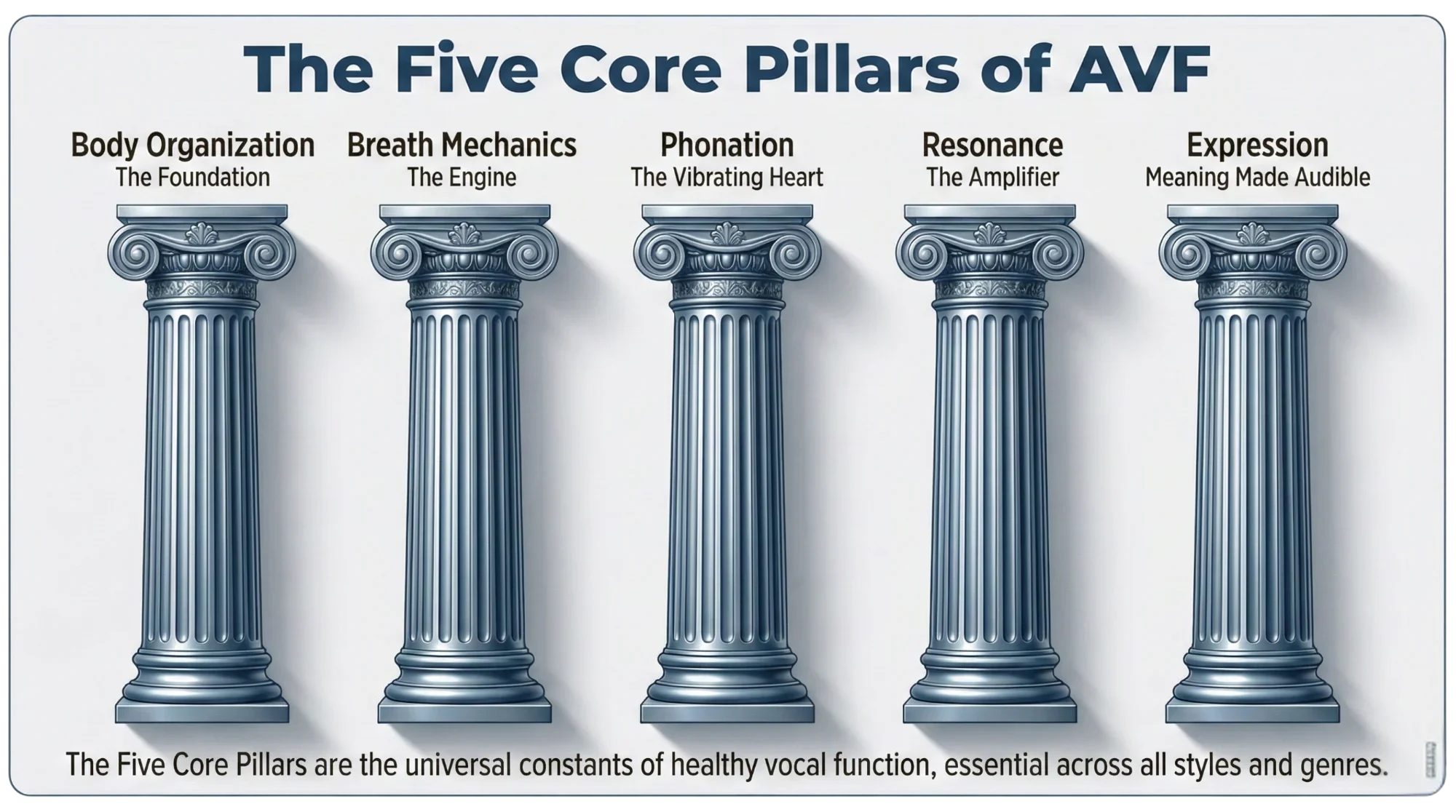
Pillars The five foundations of healthy voice my framework is built on.
The non-negotiable foundations of healthy vocal function in AVF: Body Organization, Breath Mechanics, Phonation, Resonance, and Expression. These remain constant across all styles and contexts.
Polyvagal Theory Speaking A widely taught, and actively contested, model of nervous-system states.
Stephen Porges's neuroscientific model describing three hierarchical autonomic states: ventral vagal (social engagement/safety), sympathetic (mobilization/fight-flight), and dorsal vagal (shutdown/freeze). Widely taught and clinically influential, and also actively contested—a large international panel challenged its core premises in 2026. Used in this book as descriptive vocabulary for states speakers recognize, not as settled mechanism.
Presbylarynx /ˌprɛzbɪˈlærɪŋks/ prez-bih-LAIR-inks The age-related changes in the larynx itself.
Medical term for age-related changes in the larynx including vocal fold atrophy, bowing, reduced mucosal wave, and decreased vibration efficiency. Results in characteristic voice changes in older adults.
Presbyphonia /ˌprɛzbɪˈfoʊniə/ prez-bih-FOH-nee-uh The voice changes you hear when those age-related changes affect the sound.
Age-related voice changes perceived as weak, breathy, or strained quality resulting from presbylarynx and other aging-related physiological changes.
Pressed Phonation A squeezed, strained tone from closing too hard against too much pressure.
Voice quality resulting from excessive vocal fold closure (hyperadduction) combined with high subglottal pressure. Sounds strained, harsh, or squeezed. Inefficient and potentially injurious if chronic.
Projection Your voice reaching the listener it is meant for.
Voice reaches intended listener for the task.
Worth being clear about: Not a synonym for loudness.
Proprioception /ˌproʊprioʊˈsɛpʃən/ proh-pree-oh-SEP-shun Your sense of what your own body is doing — and what you learn to read while singing.
The body's sense of its own position, movement, and effort in space. Vocal proprioception—awareness of internal sensations during phonation—develops through training and allows self-monitoring during performance.
Prosody /ˈprɒsədi/ PROSS-uh-dee Speaking The music of speech: rhythm, stress, pitch and pace.
The musical elements of speech including rhythm, stress, intonation, and tempo. Primary carrier of emotional meaning in spoken communication. Often called "the music of speech."
R
Registration Singing The quality changes that happen systematically as you move across your range.
The perceptible quality changes that occur systematically across vocal range, resulting from coordinated shifts in laryngeal mechanism, acoustic resonance, and neuromuscular pattern. Singers experience registration as distinct vocal qualities (registers) with characteristic sounds and sensations.
Resonance /ˈrɛzənəns/ REZ-uh-nunce The part of your tone that makes a voice carry.
One of AVF's Five Core Pillars. The acoustic amplification and filtering of vocal fold vibration through the vocal tract (pharynx, oral cavity, nasal cavity). Resonance shapes timbre, enhances projection, and defines stylistic character.
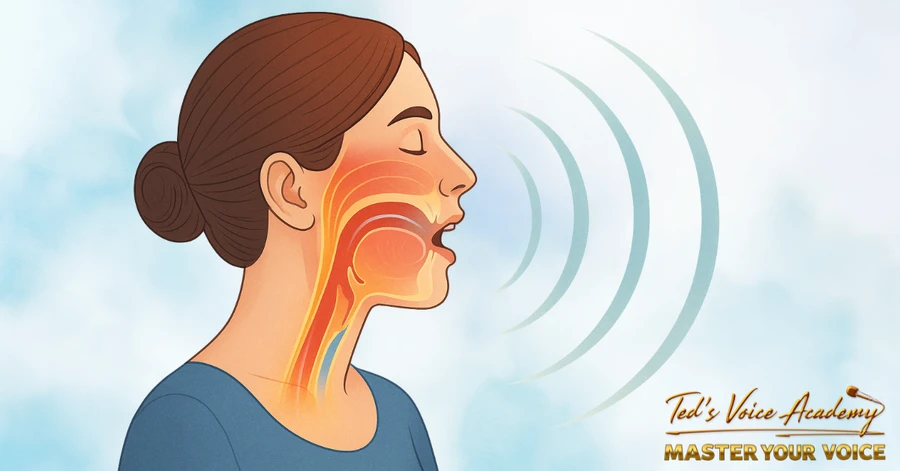
Resonance Shape One of the Eight Dials: the shape of your vocal tract, and which overtones it lifts.
One of the Eight Dials. The configuration of the vocal tract determining which harmonics are amplified. Adjustable through tongue position, lip rounding, pharyngeal width, and laryngeal height to create diverse timbral colors.
Ring / brilliance The audible presence in a tone that makes it read as alive.
Practical umbrella for audible tonal presence.
Worth being clear about: Does not prove mechanism.
S
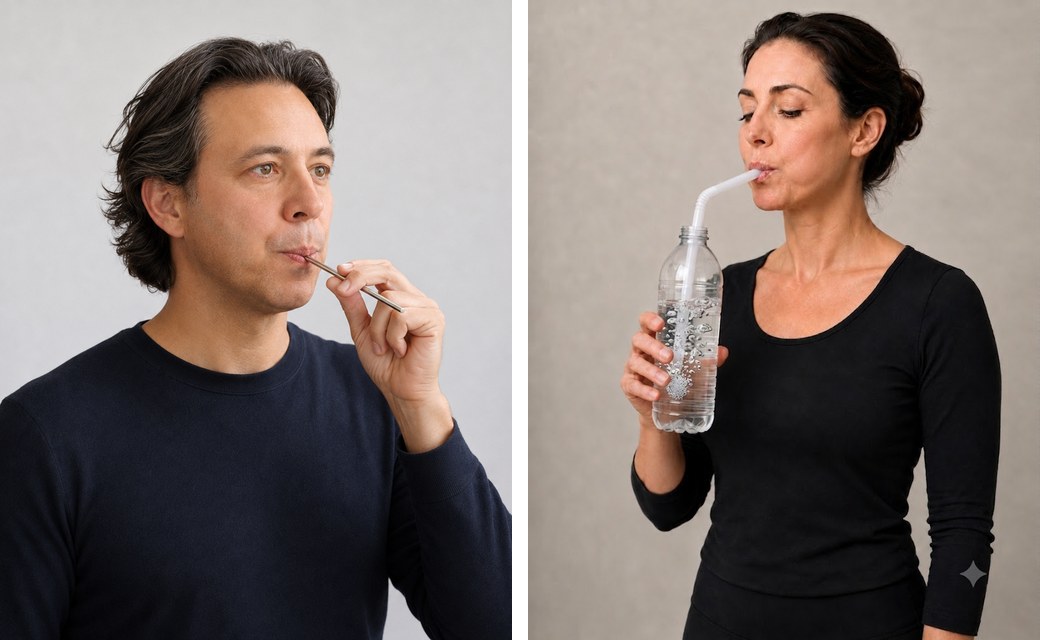
Semi-Occluded Vocal Tract Narrowing the mouth, as in humming or singing through a straw.
Vocal exercises performed with partial obstruction of the vocal tract (e.g., lip trills, tongue trills, straw phonation, voiced fricatives). Create beneficial back-pressure (inertive reactance) that assists vocal fold closure and reduces phonation trauma. Highly valuable for warm-up, cool-down, and rehabilitation.
Singer's Formant Singing A cluster of strengthened overtones that lets a voice ride over an orchestra.
A cluster of enhanced harmonics around 2500-3500 Hz in the spectrum of well-trained classical singers, created by specific resonance strategies. Allows voice to project over orchestral accompaniment and creates characteristic "ring" quality.
Source-Filter Theory The model behind everything: your folds make a sound, your vocal tract shapes it.
Acoustic model of voice production stating that the vocal folds generate a sound source (with fundamental frequency and harmonics) which is then filtered and shaped by the vocal tract resonances. The interaction between source and filter creates perceived voice quality.
Spectral slope How quickly the energy in your tone falls away as frequency rises.
Rate at which harmonic energy tends to fall with frequency.
Worth being clear about: Influenced by source behavior.
Spectral Tilt The balance of low against high frequencies — what makes a voice read dark or bright.
The balance of energy between lower and higher frequencies in a voice's harmonic spectrum. Steeper tilt (more low-frequency energy) sounds warmer/darker; flatter tilt (more high-frequency energy) sounds brighter/more brilliant.
Squillo Singing The ringing core inside a fuller classical tone.
Ringing core within a fuller classical quality.
Worth being clear about: Not one frequency or muscle.
Stroboscopy The clinical imaging that shows your vocal folds vibrating in slow motion.
Medical imaging technique using strobe light synchronized to vocal fold vibration frequency, creating slow-motion visualization of fold vibration. Gold standard for assessing vocal fold function.
Subglottal Pressure The air pressure built up underneath your vocal folds.
The air pressure built up beneath the vocal folds during phonation, measured in cm H₂O. Primary determinant of vocal loudness/intensity. Healthy phonation requires appropriate pressure balanced with glottal resistance.
Sympathetic Nervous System Speaking The mobilising branch of your nervous system — the one that fires before you speak.
Branch of the autonomic nervous system responsible for mobilization and arousal ("fight or flight" response). Activation increases heart rate, breath rate, and muscle tension—can enhance vocal energy when regulated or create strain when excessive.
T
Tessitura /ˌtɛsɪˈtʊrə/ tess-ih-TOO-ruh Singing The part of your range a piece of music mostly sits in.
The range within which most of a piece of music sits, distinct from the absolute highest and lowest notes. Tessitura significantly affects vocal comfort and stamina more than occasional extreme notes.
The Eight Dials The eight adjustable elements that shape your particular sound.
Intensity, Adduction, Onset/Release, Laryngeal Height, Resonance Shape, Twang, Diction and Vibrato. Each one is something you turn up or down rather than a fixed trait of your voice, and a style is largely a set of dial positions. They sit beneath the Master Dial, emotional intent.
Thyroarytenoid /ˌθaɪroʊˌærɪˈtiːnɔɪd/ thy-roh-arr-ih-TEE-noyd Singing The muscle forming the body of each vocal fold, which shortens and thickens it.
Intrinsic laryngeal muscle forming the body of the vocal fold. Contraction shortens and thickens the folds, important for lower pitch production. Dominates in chest voice/M1 phonation.
Thyroid Cartilage The largest cartilage of your larynx — what people call the Adam’s apple.
The largest laryngeal cartilage, forming the front and sides of the larynx. Commonly called the "Adam's apple," though present in all sexes with varying prominence.
Timbre /ˈtæmbər/ TAM-ber What makes your voice sound like yours, even on the same note at the same volume.
The characteristic sound quality that distinguishes one voice from another, or one instrument from another, even at the same pitch and loudness. Determined by the unique pattern of harmonics present in the sound.
Tremor An oscillation in the voice beyond normal vibrato.
Regular or irregular oscillation in vocal pitch, loudness, or quality beyond normal vibrato. Can result from neurological conditions (essential tremor, Parkinson's), excessive tension, or normal aging. Frequency typically 4-8 Hz.
True-fold adduction Your actual vocal folds coming toward each other.
Vocal folds brought toward midline.
Worth being clear about: Not the same as supraglottic narrowing.
V
Vagus Nerve /ˈveɪɡəs/ VAY-gus The nerve running from your brainstem through your neck, affecting breathing and the larynx.
The tenth cranial nerve, extending from brainstem through neck and thorax. Critical component of parasympathetic nervous system affecting heart rate, breathing, and laryngeal function. Central to polyvagal theory's application to voice.
Ventral Vagal Response Speaking The settled, socially engaged state, heard as warm tone and easy pacing.
Term from Polyvagal Theory for the social engagement response, associated in that model with the ventral branch of the vagus nerve and a physiological state of safety and connection. Manifests vocally as warm tone, fluid prosody, and authentic expression. See Polyvagal Theory for the status of the underlying model.
Vibrato /vɪˈbrɑːtoʊ/ vih-BRAH-toh Singing The small, even wave in pitch that appears in a freely produced sustained note.
Regular, periodic oscillation of pitch, intensity, and timbre occurring naturally in healthy, balanced singing. Typical rate is 5-7 oscillations per second with pitch variation of approximately ±¼ semitone. Results from coordinated fluctuation in breath pressure, laryngeal tension, and resonance.
Vibrato Singing One of the Eight Dials: whether that wave is present, and how fast and wide.
One of the Eight Dials. The presence, rate, and width of tonal oscillation. Adjustable from straight tone (minimal oscillation) to wide/slow vibrato, serving different stylistic and expressive purposes.
Vocal Folds The two small bands in your throat that vibrate to make sound.
Paired bands of tissue in the larynx that vibrate to produce sound. Consist of multiple layers (epithelium, lamina propria, vocalis muscle) with complex biomechanical properties. "Vocal folds" is anatomically more accurate than "vocal cords."
Vocal Fry The low, rattly crackle at the very bottom of your voice.
The lowest vocal register characterized by very slow, creaky vibration of the vocal folds at frequencies typically below 70 Hz. Can be used expressively or may appear as habitual speech pattern.
Vocal Hygiene The everyday habits that protect and support your voice.
Practices supporting vocal health including adequate hydration, appropriate voice use/rest balance, management of environmental factors (humidity, allergens), treatment of reflux, and avoidance of phonotraumatic behaviors.
Vocal Tract The resonating spaces above your vocal folds: throat, mouth and nose.
The resonating spaces above the vocal folds including the pharynx (throat), oral cavity (mouth), and nasal cavity. The tract's shape determines which harmonics are amplified, creating vocal timbre.
Voice Type /fax/ FAHK Singing How voices are classified — soprano, mezzo, alto, tenor, baritone, bass.
Classification system for voices based on range, tessitura, timbre, and other vocal characteristics. Common categories include soprano, mezzo-soprano, alto, tenor, baritone, and bass, with numerous sub-classifications.
Vowel Modification Singing Adjusting a vowel as you climb, so the note stays free.
The strategic alteration of vowel shapes (particularly in upper range) to maintain acoustic efficiency and vocal freedom. Allows formant-harmonic alignment that preserves resonance as pitch rises. Essential skill for classical singing and useful across all styles.
W
Whole-System Integration The goal: every pillar and every dial working as one.
AVF's highest goal describing the state where all Five Pillars and Eight Dials function in coordinated balance, with physiology, emotion, cognition, and artistry operating as one adaptive system. Technical and expressive functions become inseparable.
One voice lesson in your inbox, once a month
Master Your Voice Monthly is free. Each issue is a structured mini voice lesson, the same material I use in private coaching, with no ads and no sponsorships. One issue a month, and you can leave any time.
Already a subscriber? Every past issue is in the newsletter archive.
The reference library behind these words
Knowing what a term means is the start. Inside the Online Voice Studio the same ideas come with the warm-ups, handouts and recordings that teach them — Vocal Fit, the Studio Library, the practice apps and every online course I have made.
See what is in the Online Voice Studio →