
You know something isn't landing. For singers, it shows up as a windiness underneath the tone — long phrases feel expensive, quiet notes disappear, recordings reveal an airy layer that blunts the sound. For speakers, it shows up differently: the voice that fades before the sentence ends, that loses authority in a large room, that feels thin on camera or exhausted after a full day of talking. The person who says "you have such a soft voice" when what they mean is they can't quite hear you.
Whether you sing or speak for a living — or both — the underlying cause is often the same. And so is the fix.
This post gives you real answers to both.
What Causes a Breathy Voice?
Your voice is made by two small folds of tissue inside your larynx. When you speak or sing, they close together and vibrate — hundreds of times per second. Each full closure creates a tiny burst of sound. Those bursts stack up into the tone you hear.
When the folds close fully and efficiently, the sound has core. It carries. For a singer, phrases feel long enough and the tone feels present. For a speaker, the voice fills the room without pushing, holds attention without effort, and stays consistent across a full day of use.
When the folds don’t close all the way, air leaks through the gap continuously. You still get some vibration, but you also get a steady stream of turbulent air passing through. That turbulence is the breathiness underneath the sound.
The voice feels like it requires effort because it does — more than it should. By midday, by the third hour of rehearsal, by the end of a long meeting, the tank is empty and the voice shows it.
Before You Self-Diagnose: A Note That Matters
Everything in this article assumes your breathiness comes from a trainable habit or coordination pattern. That is often true. Breathiness can also be a symptom of something that needs medical attention before any training begins.
Vocal nodules are callus-like growths that form on the folds from repeated stress. Polyps are fluid-filled lesions that can develop from a single vocal trauma — one bad night of pushing through illness, one hemorrhage during a demanding performance or presentation. Vocal fold cysts, hemorrhage, and other structural changes all produce breathiness. So does a paralyzed or weakened fold that physically cannot close. None of those conditions respond to exercises. Some of them get worse if you push through them.
When to see a laryngologist first
See a laryngologist — a physician who specializes in the voice — before training if you notice any of these:
- Sudden onset — breathiness that came on abruptly, not gradually over time
- Pain when speaking or singing
- Unusual fatigue — a voice that gives out fast, even at low volume
- Lost range or projection that wasn’t an issue before
- Persistent hoarseness following an illness that hasn’t cleared after two to three weeks
- Any voice change that worries you
A laryngologist can perform a laryngoscopy — a visual examination of your vocal folds using a small camera — to see exactly what’s happening at the tissue level. That examination takes minutes and gives you information no amount of careful listening can provide.
If something structural is present, you need that diagnosis. Treatment for a hemorrhage or a cyst is completely different from training for a coordination habit, and working hard on the wrong problem can delay healing or make the underlying issue worse.
If you’ve been checked and cleared, or if your breathiness fits the gradual, habitual pattern described in this article, the training approach that follows is appropriate for you.
For more on protecting your voice, visit the Vocal Health Hub.
Breathiness Is a Health Issue — Not Just a Sound Preference
Breathiness tends to get framed as a quality preference. Soft versus clear. Intimate versus projected. For singers, a breathy tone is sometimes an intentional and beautiful choice — Billie Eilish has built a career on close-miked, intentionally airy production. For speakers, a slightly warm or gentle quality can read as approachable and human.
The problem is when breathiness isn’t a choice. When it’s the only option available.
A voice running with incomplete fold closure is working harder than it needs to. Every phrase costs more air, so the respiratory muscles work harder to compensate. Harder work means faster fatigue. Fatigue means less precision. Less precision leads to pushing — more pressure, more throat tension, more effort to force the sound out.
Speakers feel this as the voice that gives out during a long class, a training day, or a multi-hour presentation. Singers feel it as the voice that’s spent before the second set, the rehearsal that leaves the throat raw. In both cases, the root cause is the same inefficiency compounding over time.
There’s also a tissue issue. When the folds close fully across their length, contact forces distribute evenly. When they close partially, forces concentrate in a smaller area — more stress per millimeter of tissue, repeated thousands of times across every session. Over a career, that adds up.
Working on vocal clarity is about building the efficiency that lets the voice do more — choose more, sustain more, express more — with less wear. That’s the same principle behind good breath coordination.
Six Causes of a Breathy Voice (And Why Yours Matters)
Breathiness isn’t one problem. It’s a category of problem with six common causes, each requiring a different approach. Identifying yours is the most important step you can take before reaching for exercises.
1. Incomplete fold closure
The most fundamental cause. The folds haven’t developed the coordination to close fully on each cycle. This is trainable in both singers and speakers and responds well to consistent, focused work.
2. Breath management problems
This goes two directions:
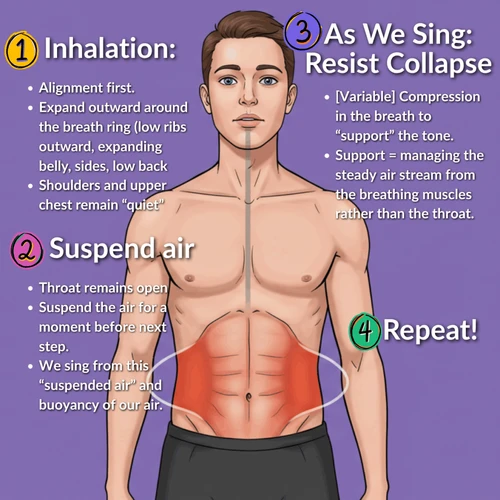
- Over-blowing — more air pressure than the folds need, which blows them apart before they complete their closure. Singers often develop this from being told to “use more breath support” without learning how to manage the airflow. Speakers develop it under stress, pushing harder in a large space, or when the stakes feel high.
- Collapsed breath — letting the breath fall away mid-phrase, starving the folds of the steady pressure they need.
Both patterns produce breathiness. They require opposite responses, which is why identifying your specific pattern matters.
3. Postural misalignment
This one surprises people. The larynx connects to the bones and muscles of the neck, skull, and collarbone. Forward head posture — common in anyone who sits at a screen for hours — puts tension into those structures, which transfers directly into the laryngeal system.
Teachers, attorneys, clergy, singers, and anyone else who talks for a living and works at a desk often arrive at their performing or speaking context carrying hours of accumulated postural tension. The voice shows it. Alignment plays a bigger role in this than it usually gets credit for.
4. Register instability
Primarily a singing concern, though speakers who use a wide pitch range — educators, storytellers, preachers, performers — feel a version of it too.
In singers, the passaggio is the transitional pitch zone where the voice shifts between its heavier and lighter coordination. Breathiness concentrated in a specific part of the range, especially in or just above that transition, often traces back here. The instinctive response — adding more air — makes it worse. What the transition needs is balanced coordination, not increased pressure.
5. Learned habits
The most common cause among contemporary pop singers and, increasingly, among speakers shaped by podcast culture and close-miked media.
We learn our voices largely by imitation. A speaker who has absorbed thousands of hours of intimate, close-miked podcasts as their model for “how a good voice sounds” may unconsciously adopt that airy, low-energy fold closure as their default — and then find it completely inadequate in a lecture hall or a boardroom. A singer raised on breathy pop production faces the same gap when the microphone isn’t there to compensate.
The voice you learned by listening isn’t necessarily the voice your body is built to produce. Finding your authentic vocal identity means building from your actual instrument, not an imitation of someone else’s.
6. Fatigue and vocal load
Different from the others because it’s often temporary and directly reversible. A fatigued fold doesn’t contract as precisely as a rested one. A dehydrated fold surface vibrates less efficiently.
Teachers who talk for six hours before an evening rehearsal, pastors who speak three services on Sunday, touring singers with no recovery time — all will show increasing breathiness that reverses with rest and better load management.
The fix here isn’t more technical training. It’s smarter scheduling and better recovery habits. The same principle applies to morning voice — sometimes the voice just needs time and hydration, not exercises.
Two Exercises to Fix a Breathy Voice Today
These work for singers and speakers equally. Five minutes before you use your voice in any demanding context.
Exercise 1: The S vs. Z comparison
This is both a diagnostic tool and a training exercise:
- Take a full breath
- Exhale on a long, steady sssss — a voiceless hiss. Time it.
- Take another full breath
- Sustain zzzzz — the voiced version of the same sound. Time it.
What to look for: The Z should last considerably longer, because efficient phonation converts air to sound and spends it more slowly. If your Z and S times are close, your phonation isn’t converting air to tone efficiently.
Track this number weekly. As your efficiency builds, the gap grows. This is one of the most reliable progress markers available without equipment.
Exercise 2: Straw phonation

- Get a regular drinking straw
- Place it between your lips and produce a comfortable pitch — speaking pitch for speakers, mid-range for singers
- The straw creates back-pressure that helps your folds find their balanced vibrating position with less effort
- Sustain a few pitches, then glide gently up and down through your comfortable range
- After a few minutes, remove the straw and speak or sing the same pitches on an open vowel
The open sound is usually cleaner and more present after the straw work. That transfer is the training effect you’re building.
For more tools like these, see 3 tools for faster vocal progress.
What Vocal Clarity Really Means for Singers and Speakers
Clear phonation isn’t one sound. A voice with efficient fold closure can still be warm, conversational, intimate, or expressive in whatever way the moment calls for. Tone color and phonatory efficiency are separate variables. The goal isn’t to make you sound formal or projected or classical. The goal is to give you more options than you currently have.
For speakers: endurance, authority, and consistency across long days. Vocal projection comes from efficiency, not volume.
For singers: phrase length, dynamic control, and the ability to use breathiness as a deliberate color rather than a default limitation. That’s artistic freedom through technique.
For both: a voice that costs less to use — which means more left in reserve when it matters most.
The people who make the most meaningful changes aren’t the ones who work hardest in a single week. They’re the ones who stay consistent over months, build their awareness gradually, and trust that the voice responds to patient, intelligent work.
Your voice has more in it than you’re currently accessing. These exercises are the start of finding out how much.
Frequently Asked Questions
What causes a breathy singing voice? A breathy singing voice is usually caused by incomplete vocal fold closure — the folds don’t come together fully on each vibration cycle, allowing air to escape without being converted into tone. Common contributing factors include breath management habits, postural tension, register transitions (especially around the passaggio), and learned imitation of breathy vocal styles. In most cases, this is a trainable coordination pattern.
Can you fix a breathy speaking voice? Yes. A breathy speaking voice usually comes from habitual patterns of fold closure and breath use, and those patterns respond well to targeted exercises. Straw phonation and the S-vs-Z comparison are effective starting points. If breathiness appeared suddenly or is accompanied by pain, see a laryngologist first to rule out a medical cause.
Is a breathy voice bad for your vocal health? When breathiness is the default rather than a deliberate choice, it means the voice is working harder than necessary on every phrase. That extra effort leads to faster fatigue, compensatory tension, and uneven stress on the vocal fold tissue — all of which compound over a career. Building more efficient phonation reduces wear and extends vocal longevity.
How long does it take to fix a breathy voice? Initial changes usually appear within two to four weeks of consistent daily practice — even just five minutes a day. Deeper, lasting coordination changes typically develop over two to three months. The timeline depends on the underlying cause: a breath management issue may shift quickly, while a deeply learned habit pattern takes longer to retrain.
Do voice coaches help with breathy voices? Yes — identifying the specific cause of breathiness and matching it to the right approach is exactly what individual coaching provides. A coach can hear and see things you can’t assess on your own, and guide you through exercises tailored to your particular pattern. Reach out here to start a conversation.
Ted Chamberlain teaches voice at Ted’s Voice Academy in Lacey, Washington. He coaches both singers and speakers using the Adaptive Voice Framework — a system built on forty years of vocal teaching that treats every voice as a unique instrument.