Forty-five years ago, I walked into a barbershop chorus rehearsal for the first time, and something happened to me that I didn’t have words for.
I’d sung before. I knew what music was. I thought I understood what harmony sounded like. But when that chorus locked into a chord — and I didn’t even know what “locked” meant yet — the sound hit me somewhere I wasn’t expecting. Not just in my ears. In my chest. In my bones. Something about it felt physical in a way that music hadn’t felt physical to me before.
I didn’t understand it. I couldn’t explain it. I just knew I had to have more of it.
Then the director called a break, and three guys pulled me aside.
They taught me a tag.
If you’re new to barbershop, a tag is the ending section of a song — short, concentrated, and built almost entirely around the kind of chords this style does better than anything else in music. No melody to hide behind. No rhythmic complexity to distract you. Just four voices stacking into harmony and holding it long enough for something extraordinary to happen. Experienced barbershop singers will tell you that a great tag is where the style reveals itself most completely. They’re right.
These three men taught me my part — a handful of notes, nothing complicated — and then we sang it together.
I was not prepared for what happened.
The chord we made didn’t sound like four people. It sounded like more than four people. There was something present in that sound that none of us were producing — a tone, a resonance, a kind of luminous extra voice floating somewhere above or around the chord. I could hear it clearly. I looked at the other three men to see if they were doing something I wasn’t aware of.
They were smiling. They knew exactly what I was hearing.
I had no framework for it. No vocabulary. Couldn’t have explained it to another person if I’d tried. But something had just happened in that brief passage of music that reached into me and took hold.
I was hooked. Not casually interested. Not pleasantly entertained. Hooked. The way you get hooked on something when it reaches a part of you that you didn’t know was available to be reached.
That moment — four voices in a rehearsal room, a tag I’d never sung before, a sound that shouldn’t have been there — set me on a journey that has now lasted forty-five years. Through vocal performance, voice science, acoustic physics, and thousands of hours working with singers at every level. Always, underneath it all, trying to fully understand what had happened to me in that room.
What was that sound? Why did it feel that way — physical, penetrating, almost overwhelming? Why did it seem to appear and disappear almost like a living thing? Why did some chords have it and others — even technically correct ones — simply didn’t?
Eventually, I found the answers.
This Is Not a Metaphor
I want to say something important before we go further, because I’ve watched people encounter this description for the first time and assume it must be poetic language. Singers being dramatic. A community’s colorful way of describing a chord they particularly like.
It isn’t.
“What I experienced that night — what barbershop singers call lock and ring — is a real acoustic phenomenon, grounded in measurable physics.”
The extra voice that I heard floating above that tag was not imagined. The expansion of sound is not a trick of enthusiasm or group psychology. Something genuinely different happens in the air when a barbershop chord truly locks, and it can be measured, studied, and understood.
That’s what I want to take you through in this article, because understanding why it happens makes you want it more. The magic survives the explanation. And because once you understand it, you can begin to pursue it deliberately rather than stumbling into it by accident the way I did four and a half decades ago.
The experience has a name in the barbershop world.
Singers call it lock and ring.
And it is one of the most extraordinary things the human voice can do.
Why Barbershop Harmony Sounds Different
To understand lock and ring, you first need to understand something about how most music in the Western world is tuned.
Almost every piano, guitar, and synthesizer you’ve ever heard uses a system called equal temperament. It divides the musical octave into twelve equal steps and it’s a practical compromise — it allows instruments to play in any key without retuning — but it is a compromise nonetheless. The notes in an equal-tempered chord are not perfectly in tune with one another in the acoustic sense. They’re close enough that most listeners never notice. But the relationships between the pitches are slightly off from what the physics of sound would naturally prefer.
Barbershop harmony doesn’t live in that compromise.
When barbershop singers are truly chasing the sound the style is known for, they’re tuning their chords according to the natural physical relationships between pitches. This is called just intonation, and it’s what the human ear finds most deeply satisfying — because it’s the tuning system that aligns with the way sound waves actually behave.
That distinction is the foundation of everything that follows.
What Sound Waves Actually Do
Sound travels through the air as waves — patterns of compression and expansion moving outward from a vibrating source. Your vocal cords vibrate, that vibration pushes on the air, and the air carries the wave outward to every ear in the room.
When two sound waves meet, one of two things happens.
If the waves are in alignment — peaks meeting peaks, troughs meeting troughs — they reinforce each other. The combined wave is stronger than either wave alone. If the waves are out of alignment — peaks meeting troughs — they partially cancel each other. The sound becomes rougher, less stable, less present.
This is why a chord can feel smooth or feel unsettled depending entirely on how the voices are tuned. When the pitch relationships are slightly off, the waves are fighting each other in ways our ears register as tension or roughness. When the relationships align, the waves cooperate.
Barbershop harmony, when it’s truly working, is the sound of four human voices whose waves are cooperating so completely that the combined result is genuinely greater than the sum of all four parts. The whole exceeds what the parts could predict.
That is the physics of expanded sound.
The Hidden Architecture of Every Voice
Here is something rarely discussed outside of voice science — and something I consider one of the most fascinating ideas in all of music.
When a singer produces a note, they are not producing a single pitch.
Every sung tone contains a whole series of additional tones layered above it — pitches the singer isn’t consciously producing, may not be trained to produce, and may not even be aware of. These are called overtones or harmonics, and they are present in every sound a human voice makes. They’re a large part of what gives each voice its unique character and color. When you can immediately distinguish one singer’s voice from another on the same note, you’re largely responding to the different distributions of overtones in those voices. In fact, spectrograms of the singing voice frequently show individual overtones with more energy than the fundamental pitch itself — these are not minor background details but a vital and powerful part of the sound.
In everyday singing these overtones blend together and we hear them simply as the quality of the voice. We don’t pick them out as separate pitches.
Something remarkable happens when singers tune a chord to the natural acoustic relationships between notes.
The overtones of different voices begin to line up with each other.
A frequency living inside the bass voice may be the exact same frequency living inside the lead voice. When those two singers tune their notes into the right relationship with each other, those matching overtones suddenly reinforce one another. The energy at that shared frequency doubles. What was barely audible in either voice alone becomes clearly, unmistakably audible in the combined sound.
And this doesn’t happen just once. It happens many times simultaneously, across the full harmonic spectrum of the chord. Multiple overtones from multiple voices aligning and mutually reinforcing, stacking acoustic energy at frequencies that none of the individual singers consciously put there.
The chord contains frequencies — real, measurable acoustic energy — that the singers didn’t individually create. The waves built it together.
That is the expanded sound. And yes — it genuinely is larger than the sum of its parts.
Not a Fifth Voice — A Column of Sound
When this alignment runs deep enough, something happens that stops listeners in their tracks.
Many barbershop singers describe hearing a “fifth voice” — an additional tone rising out of the chord at a pitch that none of the four singers are producing. And yes, that experience is real. But in my experience, “fifth voice” undersells what is actually happening.
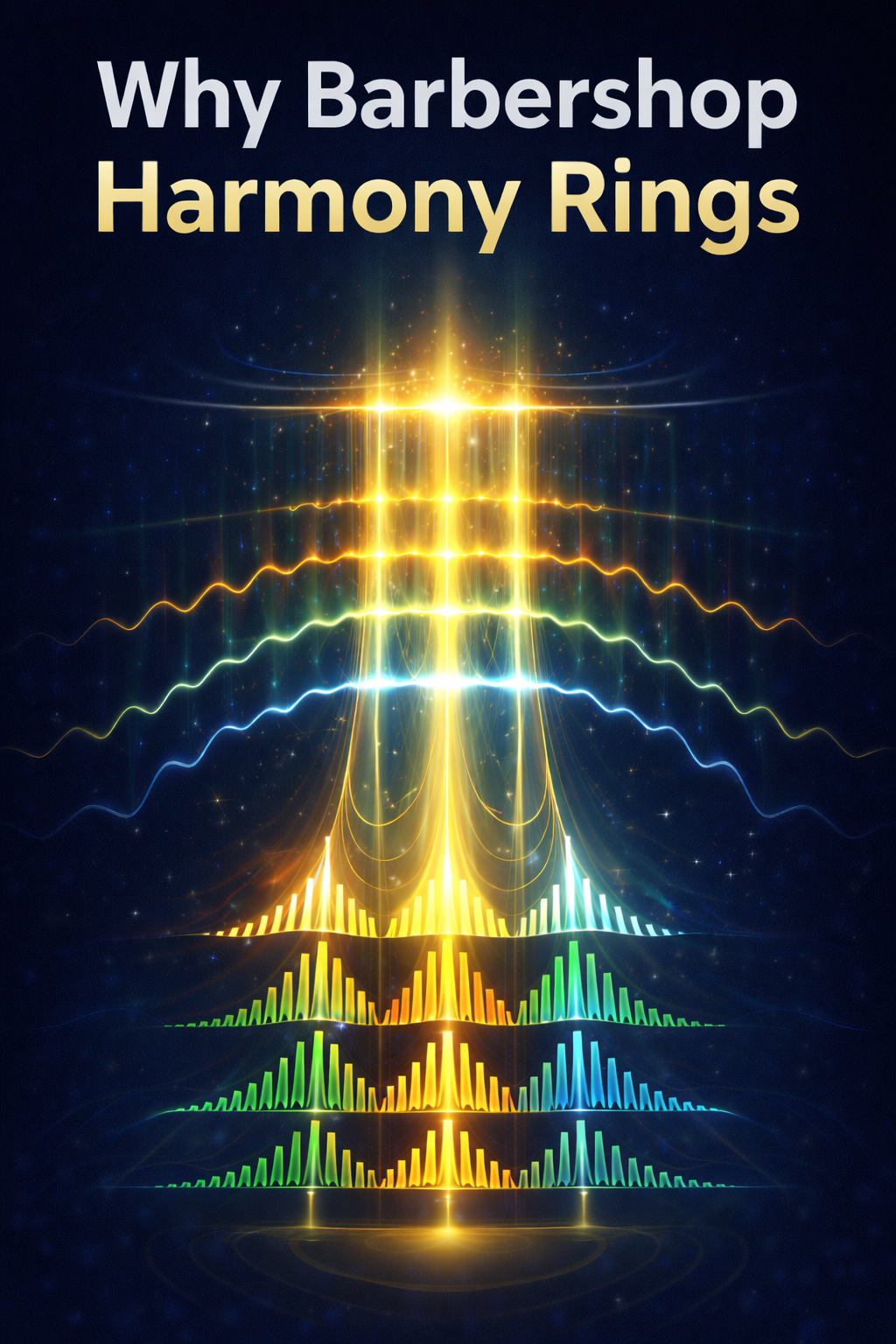
What a truly locked barbershop chord produces is better understood as a column of sound — a vertical tower of acoustic energy that extends in both directions simultaneously. Upward, the reinforced overtones stack and dance, each one an audible presence that wasn’t there a moment before, shimmering and alive at multiple levels above the chord. Downward, the interactions between the voices generate what physicists call difference tones — frequencies produced by the mathematical relationship between the sung pitches — reaching below the chord into registers that none of the singers are occupying. Barbershoppers often call these “undertones,” and they can be felt as much as heard.
The result is not a single extra voice. It is a living, resonant structure that seems to extend far beyond the four people who created it — above them, below them, and around them all at once.
Listeners in that first encounter often notice one particular tone floating above the chord — that’s what tends to get called the fifth voice. But that’s simply the overtone that caught their attention in that moment. The column is far fuller and more complex than any single tone within it.
I know this because I was that listener once. Standing in a rehearsal room, completely certain I was hearing something that the four of us couldn’t fully account for.
I wasn’t wrong.
Why This Doesn’t Just Happen
I need to be direct about something here, because I think it matters deeply for anyone who wants to pursue this sound.
Lock and ring is not easy to produce. It doesn’t happen simply because four people are singing the right notes. It doesn’t happen because everyone is generally in tune. It does not happen by accident — or if it does, you won’t be able to find it again.
Let me tell you a story that has stayed with me for years.
I was singing in a quartet — after we had won a district contest, so we were not beginners — and we were being coached by a well-renowned singing coach. We sang our first song for her. When we finished, she looked at us and said, with complete sincerity: “That was beautiful. It didn’t ring — but it was beautiful.”
That sentence stopped the room.
We had won a district contest. We were singing correctly, musically, expressively. And it didn’t ring.
What she went on to teach us was how to sing toward the ring — how to adjust our production and our tuning so that the overtones of our four voices could find each other and reinforce one another. It was a different kind of listening than any of us had been doing. A different kind of intention. Technical correctness and lock-and-ring, we learned that day, are not the same achievement. You can have one entirely without the other.
For a barbershop chord to truly lock, several things must align simultaneously.
The tuning must be genuinely precise — closer than “approximately right,” and to a degree a singer may never have been asked to work toward before.
The voices must balance. No single voice can dominate to the point where the acoustic network between them breaks down. When one part overwhelms the others, the shared overtone structure collapses — the chord may still sound full, but the precise reinforcement that produces ring simply cannot assemble itself out of an uneven foundation.
The vowels must align, so the resonant spaces in each singer’s voice are cooperating rather than pulling in different directions. When singers shape different vowels simultaneously — even slightly different versions of the same vowel — the resonant chambers of their voices are tuned to different frequencies, and the overtone structure fractures. Unified vowels create unified resonance. That unified resonance is what the ring can build on.
And the vocal production itself must be free.
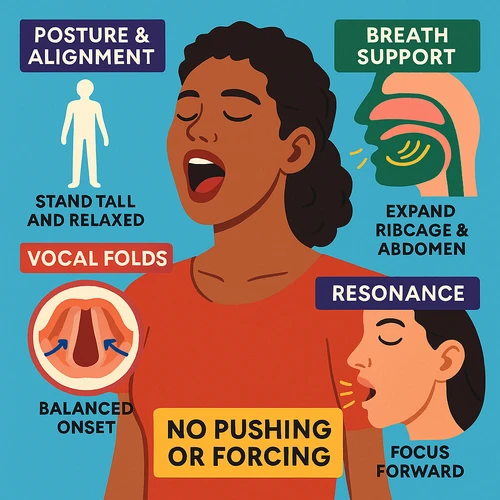
This last point is something I’ve worked on with singers for decades, and I cannot overstate it: a forced tone, a pressed tone, a breathy tone — all of these obscure the overtone structure. The harmonics become weaker and less stable. The alignment that produces lock and ring simply cannot happen because the raw material isn’t clean enough to build with.
A freely produced, resonant, balanced voice gives the chord its best possible chance of locking. A constricted or effortful tone takes that chance away almost entirely.
In forty-five years of working with singers, I’ve watched this pattern repeat itself more times than I can count: when we address the vocal production first, the tuning work becomes dramatically more productive, and the moments of lock and ring become more frequent, more reliable, and more powerful.
The voice and the harmony are not two separate subjects. They are one subject.
Why Barbershop Music Is Designed Around This
The chords that produce the most dramatic lock and ring are not random.
Barbershop harmony places enormous emphasis on a particular harmony called the dominant seventh chord — four notes built in a specific pattern that appears throughout the style with striking frequency. What makes this chord acoustically special is that its four notes relate to one another in unusually clean, simple ratios. And those ratios produce an extraordinary density of overtone alignment when the chord is tuned to its natural acoustic form.
That natural form sits slightly differently than the equal-tempered version you’d hear on a piano. The seventh of the chord in particular needs to be tuned somewhat lower than the piano version, because that is where the harmonic series of the human voice places it. That is where the alignment happens.
When singers find that tuning, the reinforcement between voices becomes almost overwhelming. Multiple overtones from all four voices converging at the same frequencies simultaneously. The chord doesn’t just ring — it blooms.
Barbershop arrangers have known this intuitively for over a century, even before anyone put physics language to it. The music is deliberately structured around the chords that make this effect possible, and arrangements are designed to sustain those chords long enough for singers to tune them into full resonance.
The music is built to make lock and ring happen.
Finding This Sound For Yourself
If you want to experience lock and ring — and I genuinely believe that anyone who loves music deeply should seek this out — there is really only one way to begin.
Sing with other people.
This effect cannot be experienced alone. It requires voices interacting in real time, building the acoustic network that makes the reinforcement possible. A barbershop quartet is the most direct laboratory for exploring it — four voices, four distinct parts, and the immediate opportunity to hear what happens when they begin to align. Barbershop society chapters exist in most cities, and they welcome singers with little or no prior experience. The communities are almost universally warm and enthusiastic, and the experience of standing inside a full chorus locked into a ringing chord is something that tends to stay with people.
If you want to develop your ear more deliberately — to build the sensitivity that lets you hear the difference between approximate tuning and the precise acoustic alignment that produces lock and ring — that’s something I’ve built a specific tool to help with. My Intonation Lab app was designed precisely for this: helping singers hear and internalize the difference between equal temperament and the pure intonation relationships that make expanded sound possible. You can’t tune toward something you can’t yet hear. Developing that sensitivity changes everything.
And if you want to work directly on the intersection of vocal production, pure intonation, and expanded sound — the place where the voice and the harmony meet — that’s the heart of what we do at Ted’s Voice Academy.
The Moment the Physics and the Human Experience Meet
I’ve spent most of this article in the physics — wave mechanics, overtone alignment, acoustic reinforcement. And all of that is real and worth understanding deeply.
But I want to end somewhere else.
When a chord locks, singers feel it before they process it. The sound fills the space around them. The vibration is physical — in the chest, in the skull, in the floor. The effort required to sustain the sound often decreases at the exact moment the sound becomes its most powerful. Four people who were four separate voices suddenly feel like one instrument.
That feeling is what keeps barbershop singers standing in rehearsal rooms and parking lots and hotel hallways at midnight, tuning the same chord for the twentieth time, chasing a sound that appeared once and was magnificent. It’s what kept me coming back forty-five years ago when I barely knew what I was chasing. It’s what keeps me coming back now, when I understand exactly what it is and it still hits me every single time.
Because here’s what I’ve learned after all these years: understanding the physics doesn’t diminish the experience. It deepens it. When you know what’s happening in the air around you — when you understand that those voices are cooperating at a level that goes all the way down to the behavior of sound waves — the moment of lock becomes something even more extraordinary than it was the first time you stumbled into it.
Four voices. One sound. Bigger than any of them could make alone.
That is lock and ring.
And once you’ve truly heard it, nothing else quite compares.
Ted is the founder of Ted’s Voice Academy and creator of the Intonation Lab app, specializing in vocal production, just intonation, and the acoustic science behind resonant harmony. He has spent forty-five years as a performer, teacher, and student of the extraordinary things that happen when voices truly align.