A Surprising Truth About How the Voice Works
One of the most astonishing things I have learned about the human voice in recent years is this:
Most of your voice never leaves your body.
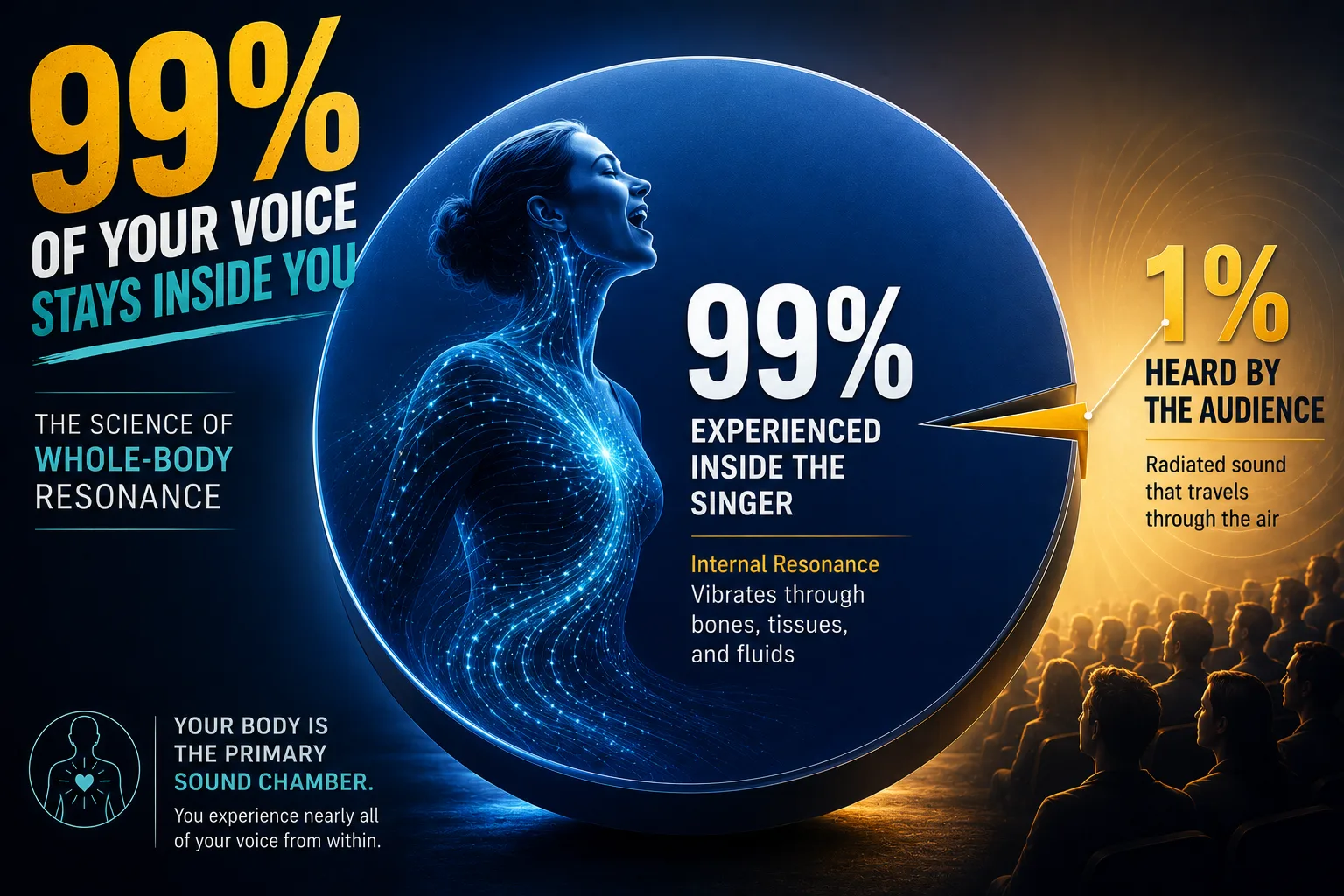
According to respected voice scientists and pedagogues including Ingo Titze and Kenneth Bozeman, less than 1% of the vibratory energy involved in singing may actually radiate outward as sound, even under highly efficient conditions such as operatic singing. That means more than 99% of your voice stays inside you.
In many singers and many styles of singing, the percentage is likely even lower.
The first time I heard this discussed at a voice conference, I honestly thought I must have misunderstood the presenter. The claim sounded impossible. How could something as powerful and resonant as the human voice send so little energy into the room?
The more I investigated, the more fascinating the science became. And suddenly, many things about singing and speaking began to make far more sense.
The Body Experiences the Voice From Within
When most people think about the voice, they think about sound traveling outward toward a listener.
From a physics standpoint, the human body is a remarkably inefficient sound radiator. Only a small portion of vocal vibratory energy becomes airborne sound. The overwhelming majority remains within the body itself.
That changes how we should think about the voice.
The body is participating in sound.
This helps explain why singers often describe sensations such as:
- buzzing in the face
- vibration in the chest
- ringing in the skull
- resonance throughout the body
- expansion
- spinning tone
- a sense of physical “aliveness” while singing
These sensations are real and measurable. Bones conduct vibration. Tissues conduct vibration. Fluids respond to vibration. Muscles respond to vibration. Connective tissues respond to vibration. The nervous system continuously monitors and interprets these sensory experiences.
The singer experiences far more of the voice internally than the audience ever hears externally.
That is a profound realization.
The Voice Is a Whole-Body Event
Many people think of the voice primarily as:
- vocal folds
- breath support
- and resonance cavities
Those elements matter greatly. And the full picture is bigger still.
The voice exists within an interconnected system involving:
- posture
- breathing behavior
- nervous system state
- muscular coordination
- movement
- sensory awareness
- emotional intent
- and connective tissue relationships throughout the body
This is one reason why tension in one area often affects vocal freedom somewhere else.
- Jaw tension can affect resonance.
- Tongue tension can affect laryngeal freedom.
- Neck rigidity can interfere with vocal efficiency.
- Restricted rib movement can alter breathing coordination.
- Collapsed posture can change tone quality and projection.
The body functions as an integrated system of related parts. The voice reflects the organization of the entire system producing it. (For more on how this shows up in everyday singing, see my post on vocal freedom and the power of proper alignment.)
Fascial Connections and Vocal Coordination
One of the most fascinating developments in modern movement science involves fascia.
Fascia is a continuous connective tissue network that surrounds and connects muscles, bones, organs, nerves, blood vessels, and other structures throughout the body.
For many years, fascia was treated primarily as passive packing material. Today, researchers recognize fascia as an important contributor to:
- force transmission
- movement coordination
- posture
- elasticity
- sensory awareness
- and whole-body mechanical integration
For singers and speakers, this matters enormously. The body coordinates vocal function through relationships among its parts.
When chronic tension patterns develop, those patterns influence the entire vocal system:
- breathing becomes less free
- the jaw may begin to brace
- the neck may compress
- rib movement may decrease
- posture may collapse
- movement may become rigid
- and resonance may become less efficient
Over time, these patterns often begin to feel normal.
This is one reason why vocal breakthroughs sometimes feel surprisingly emotional or physical. The body may be reorganizing coordination patterns that have become deeply familiar over many years.
Emotional Intent Organizes the Entire Vocal System
One of the most important insights behind AVF: The Adaptive Voice Framework is this:
The body continuously organizes around intention.
This is why emotional intent functions as the “Master Dial” within the Adaptive Voice Framework. Every emotional state subtly reshapes the entire vocal system:
- breathing patterns
- muscular recruitment
- posture
- resonance behavior
- pacing
- articulation
- vocal color
- movement
- and expressive energy
A fearful voice organizes differently than a confident one. A nurturing voice organizes differently than an authoritative one. A defensive speaker organizes differently than an emotionally connected storyteller.
These are whole-system organizational states.
The body is so deeply involved in vocal production that emotional intent influences expression and physical coordination itself. The body reorganizes around what the person is attempting to communicate.
This helps explain why singers and speakers often experience dramatic changes in vocal freedom, resonance, and efficiency when emotional connection becomes authentic. Sometimes the greatest vocal breakthrough comes from changing the organizing intent behind the sound.
Emotion is organizing the voice.
That idea sits at the very center of the Adaptive Voice Framework.
Why Stress Changes the Voice So Quickly
Have you ever noticed how quickly the voice changes during:
- stress
- fear
- grief
- anxiety
- excitement
- confidence
- or emotional connection?
The change is physiological. The nervous system continuously influences:
- breathing
- muscle tension
- posture
- resonance behavior
- articulation
- pacing
- vocal tone
- and expressive freedom
When the body shifts into protective or defensive states, the voice often reflects it immediately:
- shallow breathing
- constricted tone
- rigidity
- reduced resonance
- instability
- vocal fatigue
- or diminished expressiveness
When the body experiences safety, engagement, and emotional connection, the voice often becomes:
- freer
- warmer
- more resonant
- more expressive
- and more efficient
The voice reveals far more than words alone.
Resonance Is More Than Loudness
Many singers think resonance simply means:
- louder sound
- brighter tone
- or projection
Resonance is more than that. Resonance is about efficient vibratory interaction throughout the system.
When vocal coordination improves:
- energy transfers more efficiently
- unnecessary tension decreases
- vibratory interaction becomes more balanced
- and the body often experiences stronger internal resonance sensations
This is why efficient singing often feels free and supported. The voice begins working in coordination with the body. (I dig deeper into how this lands in real singing in my post on the forward placement myth and what resonance actually is.)
What We Practice Becomes Embodied
One of the most important truths in vocal development is this:
The body learns patterns.
Repeated behaviors gradually shape:
- coordination
- posture
- breathing habits
- muscular recruitment
- movement tendencies
- and tension strategies
Over time, these patterns become automatic.
Vocal development is about more than learning notes, exercises, or techniques. It is about developing coordinated, adaptable, expressive human communication.
What we repeatedly practice becomes embodied.
The Adaptive Voice Framework and the Interconnected Voice
The ideas explored here strongly reinforce the core philosophy behind the Adaptive Voice Framework.
The voice is adaptive. Integrated. Responsive. Contextual.
- Breath affects resonance.
- Resonance affects efficiency.
- Body alignment affects breath.
- Emotional intent affects muscular coordination.
- Nervous system state affects tone quality, expression, and freedom.
Every part of the system influences every other part.
AVF helps singers and speakers understand:
- how the entire system interacts
- how vocal variables influence one another
- how to adapt intelligently
- and how to develop a voice that is both efficient and authentically expressive
The goal is developing a voice that works in harmony with the whole person producing it.
Why Whole-Body Resonance Matters for Singers and Speakers
Understanding the voice as a whole-body vibratory system changes the way we approach vocal development.
It helps explain:
- why body alignment matters
- why tension affects tone
- why resonance feels physical
- why emotional state changes vocal quality
- why sensory awareness matters
- and why efficient singing often feels free
Every voice is different. Every body organizes differently. Every nervous system responds differently. Every singer or speaker brings unique habits, strengths, compensations, and experiences into the process.
That is why individualized guidance matters. Working with an experienced vocal coach can help singers and speakers:
- identify hidden tension patterns
- improve vocal efficiency
- strengthen resonance
- coordinate breathing more effectively
- develop authentic expression
- improve vocal stamina
- and make progress far more efficiently than trial-and-error learning alone
Your Voice Begins From Within
The human voice is one of the most remarkable instruments we possess.
Perhaps the most fascinating realization of all is this:
Long before your audience hears your voice, your body is already experiencing it from within.
If you would like to explore these ideas more deeply, AVF: The Adaptive Voice Framework examines the voice as an interconnected, adaptive system and provides practical tools for developing healthier, freer, and more expressive vocal function.
And if you are ready for personalized guidance in applying these principles to your own voice, voice coaching at Ted’s Voice Academy can help you move toward lasting, coordinated vocal growth.