Here's a question I hear often — usually quietly, from singers who've been in choirs for years and aren't sure whether asking it makes them seem ungrateful for everything the ensemble has given them:
Is singing in a choir enough? Do I actually need private lessons?
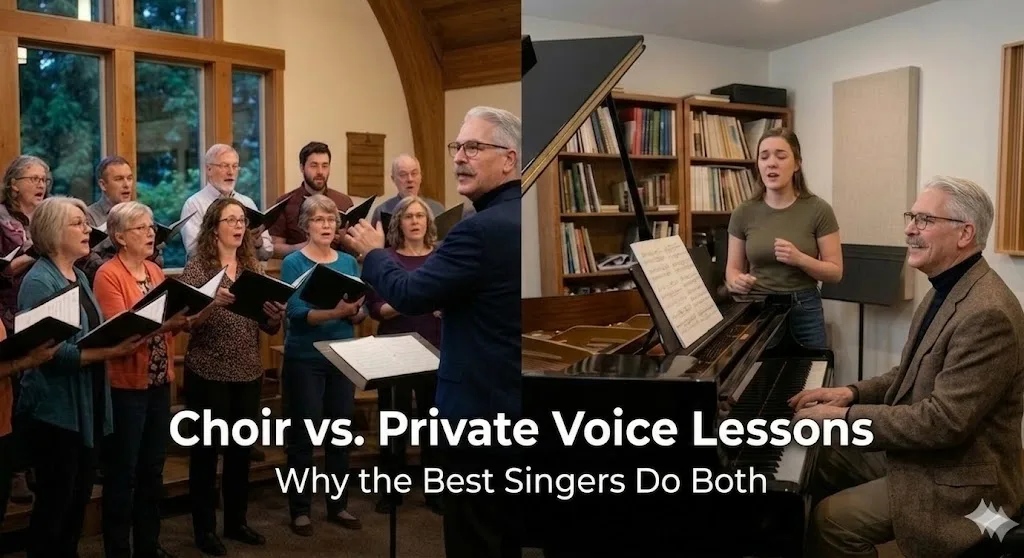
I spent nearly thirty years conducting choirs in public schools. I’ve stood in front of sections, worked through repertoire, shaped sound from the front of the room. And I’ve spent decades doing the opposite — sitting three feet from one singer, watching what their body does, hearing what their breath reveals.
Both of those experiences gave me something. And they gave me something the other couldn’t.
That’s the honest answer to the question.
Choir and private lessons train different things. Each one makes the other more valuable. And among the singers I work with here in the Lacey area — in church choirs, community choruses, barbershop quartets, and groups like Voices of the Sound — combining both is often the moment something fundamental shifts.
Here’s why.
What Choir Actually Teaches
Choir is a living musical laboratory. Every rehearsal asks you to do something no vocal exercise can replicate: function inside real music, in real time, alongside other human beings.
When you’re in a section, you’re learning to:
- Track a melodic line while watching your conductor’s hands
- Match vowel shapes to the singers around you
- Make micro-adjustments to pitch, timing, and dynamic level — often without consciously knowing you’re doing it
- Develop stamina across a two-hour rehearsal
- Absorb musical instincts, style, and discipline from the ensemble itself
Those are real skills. Serious skills. They transfer in ways that private study alone can’t produce.
I’ve watched choir singers make breakthroughs in lessons that wouldn’t have happened as quickly without their ensemble experience. Their ears are better. Their musical responsiveness is sharper. Their ability to adapt comes more naturally. Choir built that — and no amount of one-on-one work builds it the same way.
What the Rehearsal Room Can’t Do
I want to say something clearly here, because it matters: this is a reflection on the structure of rehearsal, not a criticism of choral directors.
A director’s job is to improve the collective product, every minute of rehearsal. That job is genuinely hard — and it’s a different job than teaching individual voices.
When your director says “more support on that phrase,” they’re saying it to sixty people at once. Some singers will respond exactly the way they need to. Others will press, or tighten, or reach for volume — interpreting the instruction through their own habits. And no one in that room, including the director, has the time to track what each body is doing.
That’s the structural limit of the rehearsal room. It’s simply what rehearsal is designed for.
In a private lesson, the whole hour belongs to your voice. Just yours. I can hear things that disappear inside a section. I can watch your body — the jaw, the breath, the shoulders, the posture, the onset. I can notice that you’re locking up every time you approach the top of your range. I can give you four different ways to approach a phrase until we find the one that works for your particular instrument.
The Instruction Gap
After forty years of working with singers, I’ve come to see something clearly: a lot of well-meaning choral instruction gets misunderstood — and the misunderstanding costs people.
This is how language behaves when it’s spoken to a group.
Rehearsal language is shorthand. It often works in the moment. The same instruction can mean different things in different bodies:
What the director says vs. what the body does
| What the director says | How it often gets interpreted | What’s actually needed |
|---|---|---|
| ”More support” | Push harder from the stomach | Better breath coordination |
| ”Darken your vowels” | Depress the larynx | Adjusted vowel shape with a free throat |
| ”Blend into the section” | Remove vitality from the sound | Match resonance while keeping engagement |
| ”Sing out” | Add volume | More resonance efficiency |
None of those singers were doing something wrong. They were doing exactly what they understood the instruction to mean. The gap wasn’t commitment. It was context.
Private study gives you the context. When you understand what “support” actually feels like in your own body — when you know how breath pressure and vocal fold engagement work together — you can respond to a director’s shorthand intelligently. You can translate the rehearsal room’s language into something your body already knows.
That translation is one of the most practical gifts private study can give an ensemble singer.
If any of this sounds familiar, a free discovery call is a good place to start.
What Lessons Give the Choir Singer
Here’s what changes when choir singers begin individual work:
- Pitch center steadies. Drifting sharp or flat in long phrases usually has a breath connection — and lessons surface that.
- Vowel matching improves — from understanding, not just imitation.
- Stamina increases because less energy goes toward compensating for what the voice doesn’t yet understand about itself.
- Singing becomes more intentional. Singers start choosing — tone color, phrasing weight, dynamic shape — instead of just surviving the passage.
This is the part I care most about.
My philosophy has always been that expression drives technique. Technique exists to give you the freedom to say what you mean, the way you mean it. The goal of every lesson I teach is a singer who has more options, more ease, and more authentic connection to the music. When choir singers bring that into rehearsal, the whole section feels it.
What Choir Gives the Private Lesson Student
Technique without somewhere to use it is like practicing recipes without ever cooking a meal.
Singers who work only in private lessons sometimes develop a very tidy, controlled voice — clean in the lesson room yet untested. It hasn’t been asked to sustain across two hours of rehearsal. It hasn’t had to adapt to an acoustic that shifts when sixty other voices fill the room. It hasn’t been held accountable to something larger than itself.
Choir tests what lessons build. That pressure — the live conductor, the live musical demand, the real-time listening — develops a kind of vocal flexibility that exercises alone can’t produce.
The Whole Picture
Here’s what each path builds — and where the two paths meet:
| Choir | Private Lessons | |
|---|---|---|
| Ear training | Develops naturally through live ensemble listening | Refined through targeted pitch and interval work |
| Breath management | Tested by sustained rehearsals | Built through individual technical coaching |
| Musical responsiveness | Sharpened by live ensemble demands | Deepened through expressive exploration |
| Vocal technique | Reinforced through repetition and repertoire | Diagnosed and developed one-on-one |
| Confidence | Grows through shared experience | Grows through self-understanding |
| Stamina | Built by doing | Built by efficiency |
Each one asks something the other can’t ask. Each one grows something the other can’t grow.
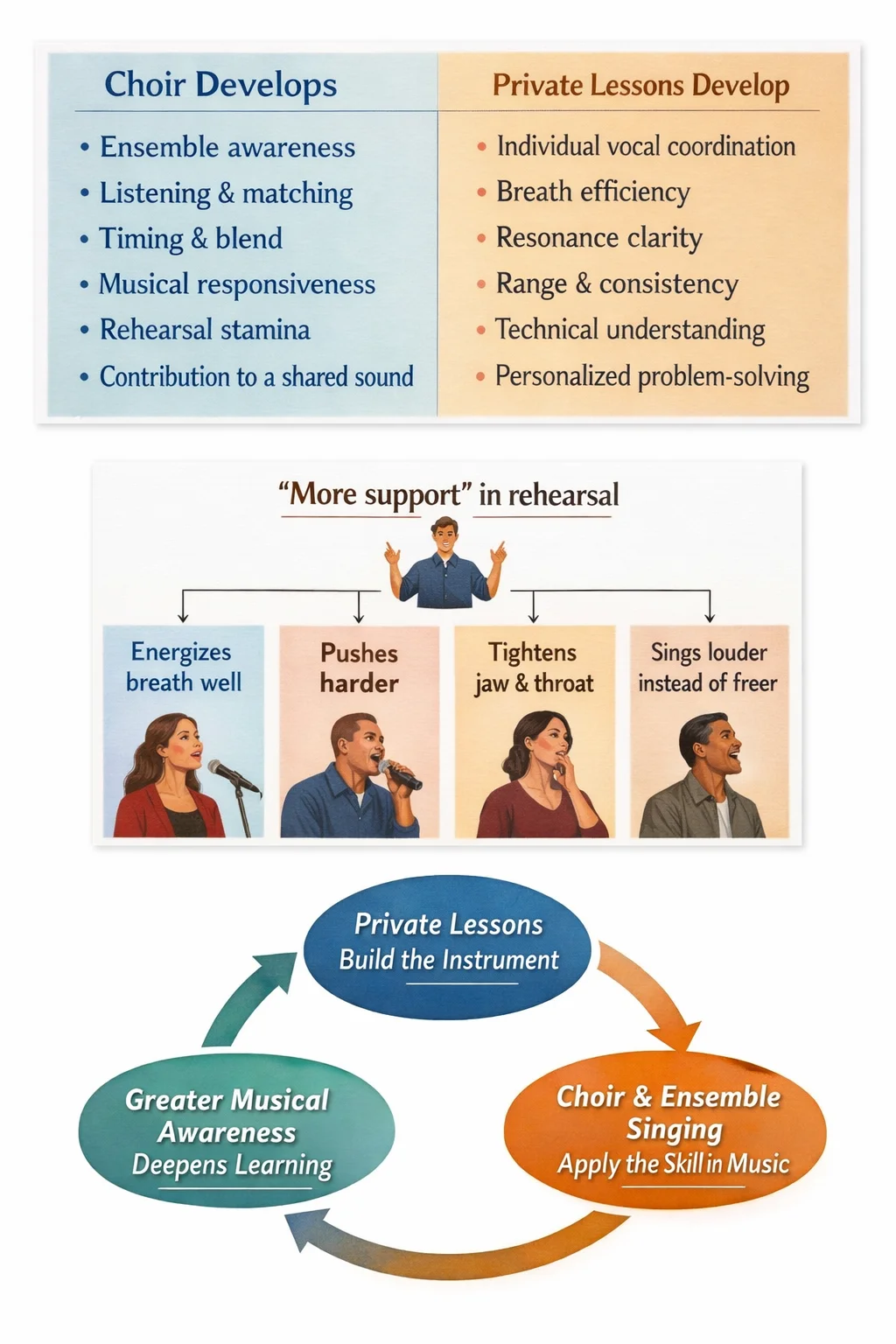
When a singer takes both seriously, growth tends to be faster, healthier, and more complete. The technique built in lessons shows up in rehearsal. The musical demands of the ensemble sharpen the technique. Good ensemble singing and good individual training are compounding investments.
Does Every Choir Singer Need Private Lessons?
Some singers participate in choral singing for the community, the joy, the repertoire — and that’s complete. Some are functioning well and are genuinely happy where they are.
Certain things show up reliably in choir singers who would benefit from individual work. If you recognize yourself in any of these, it’s worth exploring:
- Fatigue that lingers after rehearsals
- Range that feels cut off or inconsistent
- Uncertainty when a director gives a technical note
- A sense of working harder than the singing should require
- A desire to do more — solos, worship leading, auditions — with a feeling that something isn’t ready yet
Often, a handful of focused sessions shifts things significantly.
I work with ensemble singers throughout Thurston County — in Olympia, Lacey, Tumwater, and the wider region. Many of my most committed students came through the door because of something they first felt in a choir. The choir gave them the love. Private study gives them the understanding to sustain and deepen it.
Ready to Explore Private Study?
If you’re singing in a choir or ensemble in Thurston County and want to understand your voice more fully — or you’re simply curious what a lesson with me looks like — I’d love to connect.
Private coaching at Ted’s Voice Academy is designed to meet you where you are. I focus on what your voice actually needs, how it actually works, and how to bring more ease, resonance, and confidence to every rehearsal.
Start with a free discovery call — a short conversation where I learn about your goals and you learn about how I work. Reach out here and let’s talk.
Frequently Asked Questions
Do choir singers need private voice lessons? Private lessons give choir singers something the rehearsal room isn’t structured to provide: individual technical attention, direct feedback on how their specific voice works, and the context to interpret a director’s instructions more effectively. Many choir singers find that lessons make ensemble singing feel easier, more reliable, and more expressive.
Can private lessons help me sing better in choir? Yes. Singers who develop clearer understanding of breath coordination, resonance, and vocal onset typically notice improved pitch stability, better vowel matching, and greater stamina in rehearsal. The gains from individual work show up directly in ensemble contexts.
Is choir singing enough to improve my voice on its own? Choir develops real musicianship — listening, responsiveness, stamina, stylistic awareness. For singers who want to improve individual vocal function, range, or technical understanding, individual coaching adds something the ensemble setting isn’t designed to provide.
Why do choir singers sometimes still struggle even in a good ensemble? A strong ensemble sound can mask individual inefficiencies. A singer can contribute to a fine section while still using unnecessary tension or effort. Without individual attention, those habits can persist for years. Private work creates the conditions to address them directly.
Do you work with choir and ensemble singers in Thurston County? Yes. I work with singers from church choirs, community choruses, barbershop quartets, and a cappella ensembles throughout the Lacey, Olympia, and Tumwater area — in person at my Lacey studio, and virtually. Contact me here to start a conversation.
Ted Chamberlain teaches voice at Ted’s Voice Academy in Lacey, Washington. He spent nearly thirty years conducting choirs in public schools and has been coaching individual voices for over four decades. He is the creator of the Adaptive Voice Framework.