The Value We Keep Getting Wrong
Whenever a school district faces budget cuts, music is among the first things on the table. And whenever that happens, advocates for music education reach for the same set of justifications. Music improves test scores in math and reading. Music teaches discipline. Music builds teamwork. Music keeps kids out of trouble.
These things may be true. But there is a deep problem with every one of them, and it’s the same problem: they all justify music by pointing to something that isn’t music. They treat music as a delivery mechanism for outcomes that the culture has already decided matter more. And the moment you do that, you’ve made music expendable. If a cheaper, more efficient intervention comes along that raises test scores or teaches discipline or builds teamwork, then by your own logic, you should cut the choir and fund that instead. You’ve built your house on someone else’s foundation.
This is what philosophers call the difference between instrumental value and intrinsic value. Something has instrumental value when it’s useful for getting something else. A hammer has instrumental value. Something has intrinsic value when it is good in itself — when it’s part of what makes a life worth living. Love has intrinsic value. Friendship has intrinsic value. And music has intrinsic value.
Saying “keep music because it helps with math scores” is like saying “keep friendship because it lowers your blood pressure.” It may be true, but if that’s your best case for friendship, you’ve fundamentally misunderstood what friendship is.
Until our communities understand this distinction, music will always be the first thing cut, because it will always be measured against priorities it was never meant to serve. And the people who love music will keep losing the argument — not because they’re wrong, but because they’ve accepted the wrong terms.
What Music Actually Is
Music is one of the very few things that every human culture in recorded history has produced. Every single one. There are cultures without written language, without the wheel, without agriculture — but there is no culture without music. That alone should tell us something profound. Music isn’t a luxury that civilizations add once they’ve handled the basics. It is one of the basics. It’s woven into the fabric of what it means to be human.
Music is how human beings have always processed what language alone cannot carry. Grief has a sound. Joy has a sound. The sacred has a sound. When something matters so deeply that ordinary speech fails, we sing. We sing at weddings and funerals. We sing to babies before they understand a single word — and remarkably, they respond. The musical bond between a parent and infant predates language. It may be one of the oldest forms of human communication we have.
Music engages the brain in ways that nothing else does. Not as a trick for improving other skills, but because music is a uniquely complex human experience — it simultaneously activates motor systems, emotional processing, memory, pattern recognition, auditory processing, and social cognition. It does this not because it’s borrowing from other domains, but because music is its own domain, and it’s a big one. When we reduce it to a support tool for reading and math, we’re like someone who looks at the ocean and says, “Well, at least it keeps the boats floating.”
The Special Case of Singing Together
Singing together is not just one form of music-making among many. It’s arguably the most fundamental one, and it does something that no other human activity replicates.
When people sing together, their heart rates synchronize. This is not a metaphor — it is a measurable physiological phenomenon. Their breathing aligns. Neuroimaging research shows that when people sing in an ensemble, their brain activity begins to synchronize as well. Singing together is one of the most powerful bonding mechanisms our species has. It’s likely that humans sang together before they spoke in complex sentences. Some evolutionary linguists believe that group singing may have been a precursor to language itself.
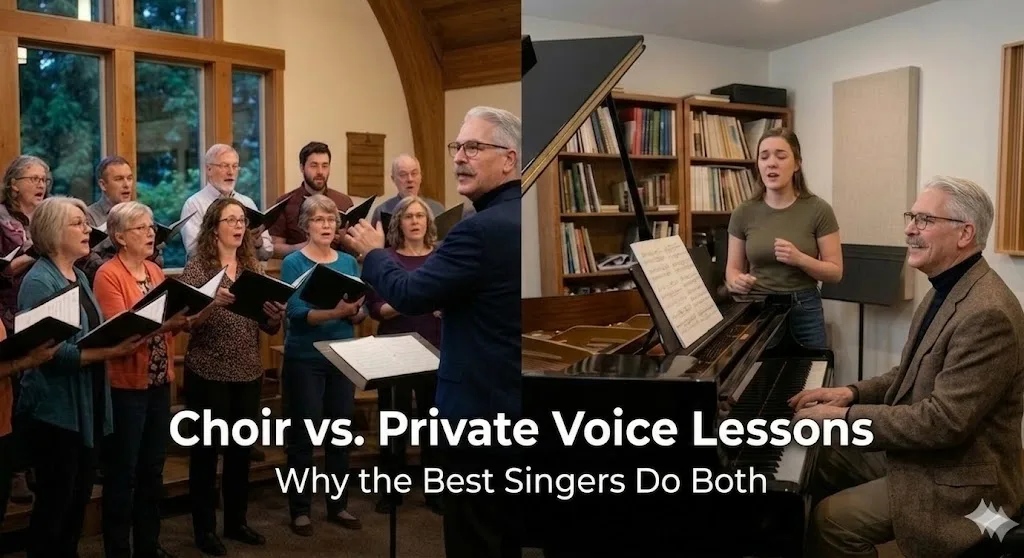
Choral singing requires something extraordinary of a person: you must simultaneously assert yourself and surrender yourself. You must produce sound with full commitment while listening so carefully to those around you that you’re willing to adjust everything — your pitch, your volume, your vowel shape, your timing — in service of something larger than your own voice.
There is almost no other activity in civic life that asks people to do this. It is, in a very real sense, training in how to be part of a community. Not as a metaphor. As a lived, embodied, breath-by-breath practice.
And the voice is unique among instruments because it is the person. There’s no mechanism between the musician and the sound. When someone sings, they are offering something that comes from inside their body, shaped by their breath, their resonance, their physical being. The vulnerability of that act — and the trust required to do it alongside others — is not something you can replicate with any other activity in a school curriculum.
What We Lose When We Cut Music
When a community cuts music from its schools, it isn’t trimming a luxury. It’s removing one of the few spaces where young people learn to do something together that isn’t competitive, isn’t graded on a curve, and isn’t primarily cognitive. It’s one of the only places in a school where a teenager is asked to feel something and express it honestly. Where a kid who struggles in every academic class might discover that they have a gift, that their body can do something beautiful, that they belong somewhere.
For many students, choir is the reason they come to school. That’s not an exaggeration — anyone who has taught secondary choral music knows students for whom that room was the only safe place in the building. The only place they weren’t failing. The only place someone noticed when they were absent.
And beyond the individual students, there’s the community dimension. A school music program is one of the few remaining things that brings an entire community into the same room — concerts, musicals, performances. In an era of increasing isolation and fragmentation, these gatherings aren’t trivial. They’re one of the last forms of shared cultural life that many communities have.
The Deeper Problem
The reason levies fail and music programs get cut is not ultimately about budgets. It’s about a culture that has lost track of what education is for. If education exists only to produce workers — to raise test scores, to improve economic competitiveness — then music will never be safe, because music doesn’t serve that purpose efficiently. Music serves the purpose of making people more fully human. And if that’s not something a community values, then the problem is much bigger than a budget line.
The ancient Greeks understood that mousike — which encompassed music, poetry, and dance — was not an elective. It was central to the formation of a person. Not because it made you better at geometry, but because a person who had no relationship with beauty, with expression, with the experience of creating something meaningful alongside others, was not yet a complete person.
We’ve somehow arrived at a moment in our culture where that understanding needs to be re-argued from scratch. And that is itself a sign of how far we’ve drifted.